
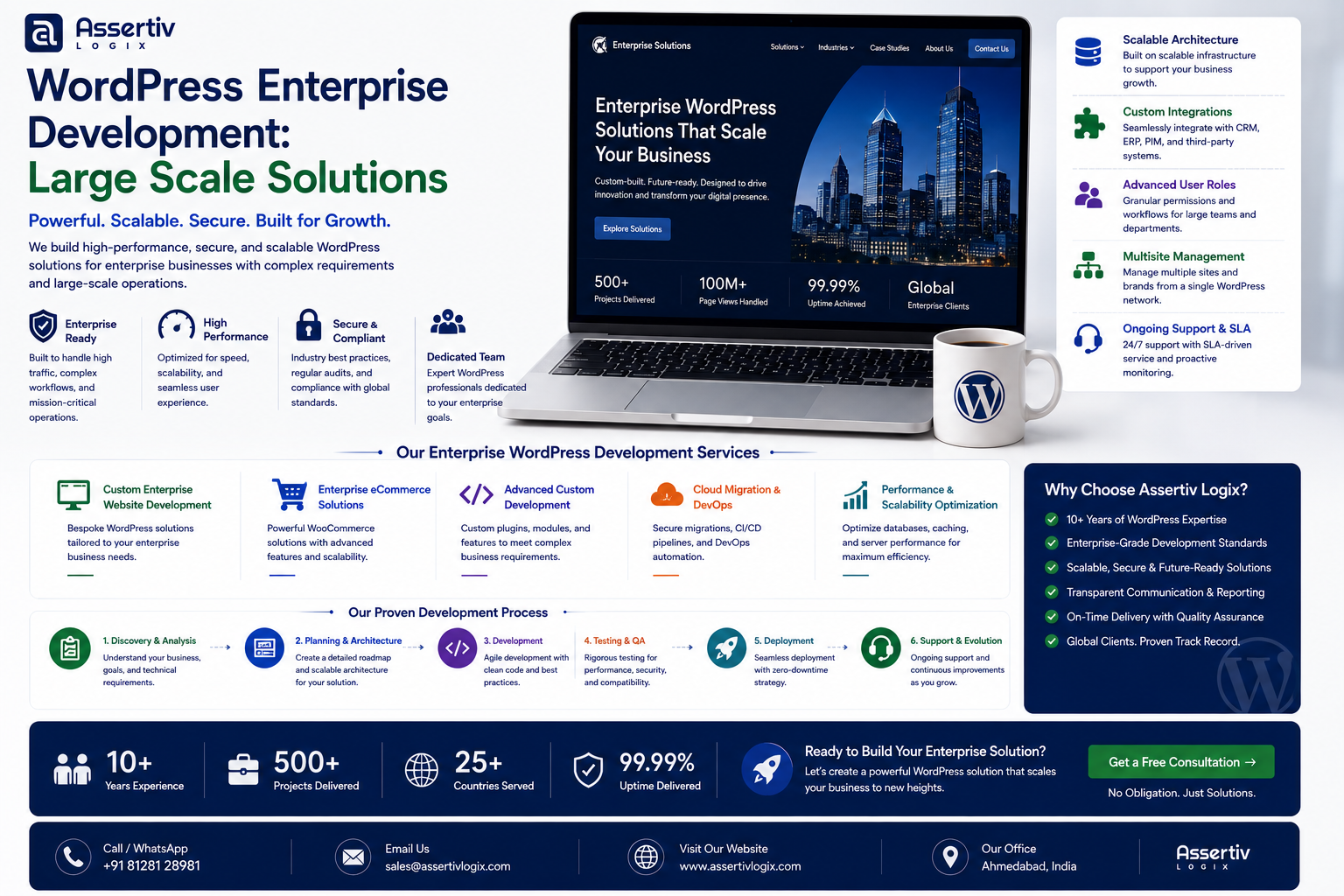
WordPress enterprise development is no longer limited to simple corporate websites or marketing pages. Large organizations increasingly use WordPress as a flexible digital platform that can support high traffic, multiple websites, complex integrations, large content libraries, multiple teams, and demanding security requirements.
For enterprises, the challenge is not simply installing WordPress and choosing a theme. A large-scale WordPress project requires careful architecture, scalable infrastructure, custom development, security controls, performance optimization, integration planning, and ongoing maintenance.
In this guide, we explain how enterprise WordPress development works, what features large organizations need, how enterprise architecture should be planned, common integrations, security considerations, performance strategies, development costs, and how to choose the right development partner.
Get expert guidance for architecture, custom development, integrations, performance, and enterprise WordPress security.
What Is WordPress Enterprise Development?
WordPress enterprise development refers to building and maintaining WordPress websites and digital platforms designed to meet the requirements of large organizations.
Unlike a typical business website, an enterprise WordPress platform may need to handle thousands or millions of visitors, large content databases, multiple editors, different user roles, several integrations, multiple regions, and strict security requirements.
Enterprise projects may include:
- Large corporate websites
- Global brand websites
- Multi-site WordPress platforms
- Enterprise publishing platforms
- High-traffic content websites
- Large WooCommerce stores
- Membership and customer portals
- Multilingual websites
- Intranet and employee platforms
- Headless WordPress applications
The official WordPress platform features provide a strong foundation, but enterprise requirements often demand additional custom architecture and engineering.
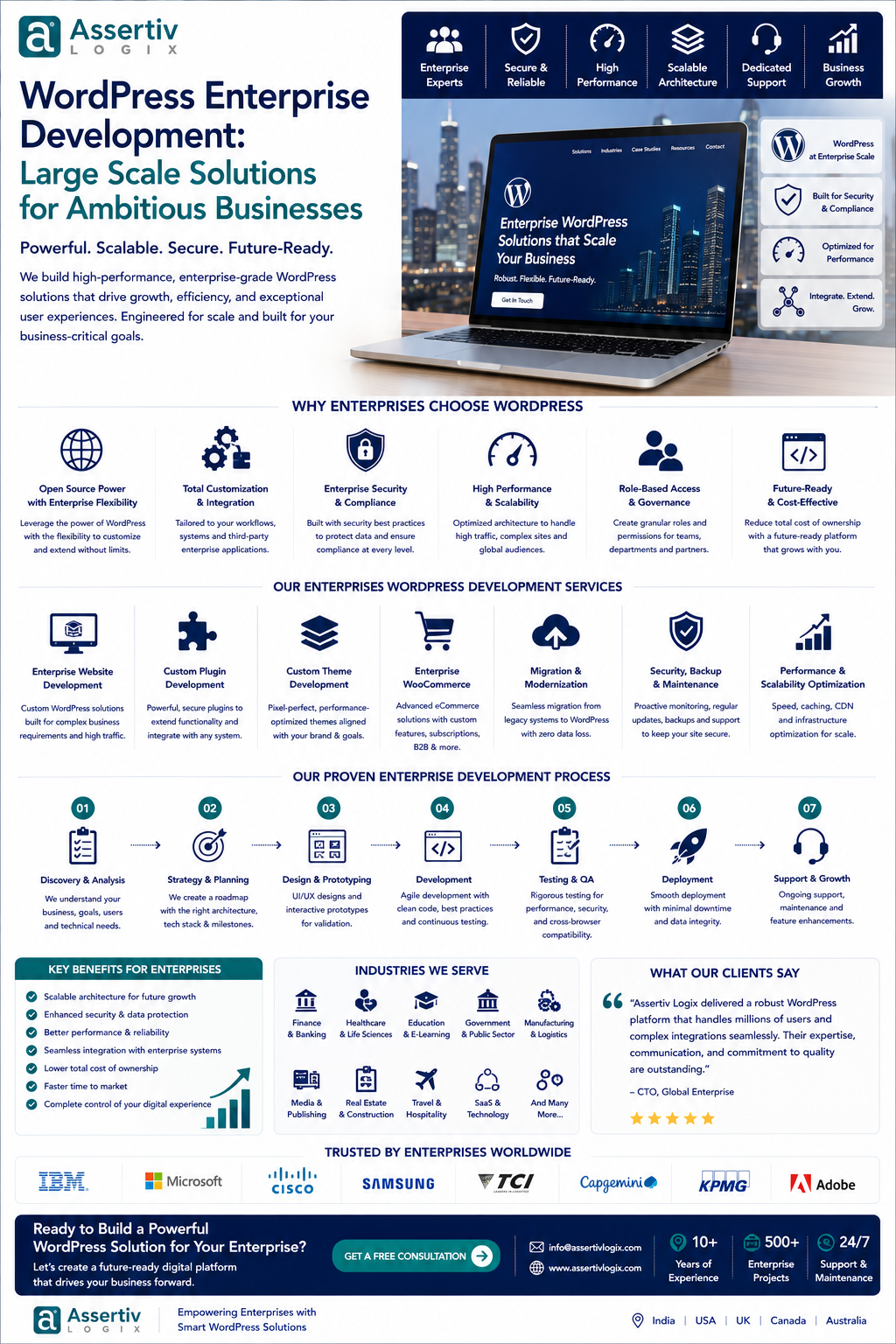
Why Do Large Businesses Choose Enterprise WordPress Development?
WordPress provides an established content management ecosystem while giving organizations significant flexibility for customization.
For large businesses, the biggest advantage is the ability to build a platform around specific business processes instead of forcing the organization to work around a rigid website system.
1. Flexible Architecture
Enterprise WordPress solutions can be designed around the organization’s content structure, user roles, integrations, workflows, and infrastructure.
2. Scalable Content Management
Large organizations often manage thousands of pages, articles, documents, products, locations, and media assets. A properly engineered WordPress installation can provide structured workflows for managing this content efficiently.
3. Custom Integrations
Enterprise websites rarely operate independently. They often connect with CRM systems, ERP platforms, marketing automation systems, payment gateways, search platforms, analytics tools, product databases, and internal APIs.
4. Strong Publishing Workflow
Large organizations may have writers, editors, legal reviewers, marketing teams, regional managers, and administrators working on the same platform. Custom workflows and permissions can help control how content moves from creation to publication.
5. Lower Long-Term Platform Dependency
With custom development, businesses can build functionality around their own requirements rather than depending entirely on a proprietary platform.
Enterprise WordPress Development vs Standard WordPress Development
A standard WordPress website may be sufficient for a small business, while enterprise WordPress development requires a much broader engineering approach.
| Area | Standard WordPress | Enterprise WordPress |
|---|---|---|
| Traffic | Low to moderate | High or unpredictable |
| Architecture | Traditional WordPress | Scalable custom architecture |
| Content | Limited content volume | Large content repositories |
| Users | Small team | Multiple teams and departments |
| Integrations | Basic integrations | Complex APIs and enterprise systems |
| Security | Standard security practices | Advanced security and governance |
| Performance | Standard optimization | Advanced caching and infrastructure |
| Deployment | Manual or simple workflow | Staging, testing, CI/CD and controlled releases |
| Maintenance | Periodic maintenance | Continuous monitoring and support |
Key Features of Enterprise WordPress Solutions
A successful enterprise platform should be designed around the organization’s actual operational requirements.
Custom WordPress Architecture
Enterprise WordPress development starts with architecture rather than visual design. Developers need to determine how content, users, APIs, databases, caching, search, media, and third-party services will work together.
The architecture should also consider future growth. A platform that works for one million monthly visitors may need a different infrastructure strategy when traffic grows substantially.
Custom Themes
Enterprise organizations often require highly customized user experiences. A custom theme provides greater control over design systems, accessibility, performance, responsive behavior, and brand consistency.
A lightweight custom theme can also reduce unnecessary code compared with a heavily generalized theme.
Custom Plugins
Custom plugins are useful when enterprise functionality does not fit standard WordPress plugins.
Examples include:
- Custom business workflows
- Advanced content management
- Custom user permissions
- Internal APIs
- Enterprise search
- Custom reporting
- CRM synchronization
- Product data synchronization
Developers can use the WordPress Developer Resources when building custom themes, plugins, APIs, and other platform functionality.
WordPress Multisite
Large organizations may operate websites for multiple countries, brands, departments, or business units.
WordPress Multisite can provide a centralized platform for managing multiple websites while allowing individual sites to maintain their own content and configurations.
However, Multisite should not automatically be selected for every enterprise project. The architecture should be based on the organization’s content, governance, infrastructure, and operational requirements.
Multilingual and Multi-Region Websites
Global companies often require websites in multiple languages and regional variations.
An enterprise WordPress solution can support different languages, localized content, regional products, currencies, legal information, and market-specific experiences.
Enterprise WordPress API Integrations
One of the most important parts of large scale WordPress development is integration with existing business systems.
Common enterprise integrations include:
- CRM platforms
- ERP systems
- Marketing automation platforms
- Customer support systems
- Payment gateways
- Product information management systems
- Inventory platforms
- Search platforms
- Email marketing systems
- Analytics platforms
- Single sign-on systems
- Internal business APIs
Instead of manually moving information between systems, API integrations can synchronize data and automate business processes.
Enterprise WordPress Security
Security becomes significantly more important when WordPress supports a large organization, sensitive business information, or high-value customer activity.
Enterprise WordPress security should include multiple layers rather than relying on a single security plugin.
Important Security Practices
- Strong administrator authentication
- Role-based permissions
- Secure hosting infrastructure
- HTTPS encryption
- Regular WordPress and dependency updates
- Security monitoring
- Vulnerability management
- Secure development practices
- Database and file backups
- Staging environments
- Access logging
- Incident response planning
Enterprise teams should also review the latest security guidance and vulnerability information from the WordPress security documentation.
Enterprise WordPress Performance Optimization
Performance is one of the most important components of enterprise WordPress development. Large websites can have thousands of pages, complex queries, large media libraries, third-party scripts, and substantial traffic.
A scalable performance strategy may include:
- Page caching
- Object caching
- CDN implementation
- Database optimization
- Query optimization
- Image optimization
- Lazy loading
- Asset optimization
- Efficient plugin architecture
- Server-level optimization
- Load balancing where required
- Performance monitoring
Teams can also use Google PageSpeed Insights to measure performance and identify opportunities for improvement.
High-Traffic WordPress Architecture
When traffic increases, simply upgrading the server is not always the best solution.
A properly designed enterprise architecture can distribute workloads and reduce unnecessary processing.
Depending on requirements, an enterprise WordPress platform may use:
- Managed cloud hosting
- CDN infrastructure
- Load balancers
- Multiple application servers
- Object caching
- Database optimization
- Dedicated search infrastructure
- Cloud-based media storage
- Automated deployments
- Monitoring and alerting
The right architecture depends on traffic patterns, application complexity, content volume, uptime requirements, and integration architecture.
Enterprise WooCommerce Development
For organizations selling products online, enterprise WooCommerce development can extend WordPress into a large-scale commerce platform.
Enterprise WooCommerce projects may require:
- Large product catalogs
- Custom checkout workflows
- ERP integration
- Inventory synchronization
- Payment integrations
- Shipping integrations
- Subscription functionality
- Customer-specific pricing
- Multiple currencies
- Regional stores
- Advanced reporting
For organizations considering WooCommerce, the official WooCommerce documentation provides technical information about the platform and its ecosystem.
Headless WordPress for Enterprise
Some enterprises choose a headless WordPress architecture where WordPress manages content while another application handles the frontend.
This approach can be useful when an organization requires highly customized digital experiences across websites, mobile applications, digital products, or other channels.
WordPress can function as the content management layer while technologies such as React, Next.js, or other frontend frameworks consume content through APIs.
However, headless WordPress is not automatically better than traditional WordPress. It introduces additional development, deployment, and maintenance complexity. The architecture should therefore be selected based on actual business requirements.
Enterprise Content Workflow and User Permissions
Large organizations need more than a simple administrator and editor model.
An enterprise platform may require different permissions for:
- Content writers
- Editors
- Marketing teams
- Legal reviewers
- Regional managers
- Product managers
- Developers
- Administrators
Custom workflows can help organizations control who can create, review, approve, publish, and update content.
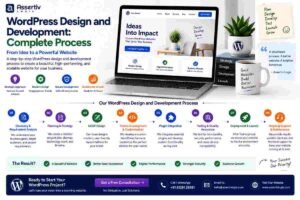
Enterprise WordPress Development Process
Successful wordpress enterprise development requires a structured development process. Large projects become difficult to manage when architecture and requirements are not defined before development begins.
Step 1: Business and Technical Discovery
The development team first identifies business objectives, users, existing systems, technical constraints, traffic expectations, content requirements, security requirements, and integrations.
Step 2: Architecture Planning
The team defines the WordPress architecture, hosting model, database strategy, caching, APIs, integrations, content structure, and deployment workflow.
Step 3: UX and Design System
Enterprise websites usually benefit from a reusable design system that supports consistency across pages, departments, and regions.
Step 4: Custom Development
Developers build the custom theme, plugins, integrations, workflows, APIs, and other required functionality.
Step 5: Quality Assurance
The platform should be tested for functionality, compatibility, accessibility, performance, security, responsive behavior, and integration reliability.
Step 6: Performance Testing
Load and performance testing can help identify bottlenecks before the website receives production traffic.
Step 7: Deployment
The production release should use a controlled deployment process with backups, rollback procedures, monitoring, and appropriate access controls.
Step 8: Continuous Optimization
Enterprise platforms require ongoing maintenance. Performance, security, infrastructure, plugins, integrations, and business requirements change over time.
How Much Does WordPress Enterprise Development Cost?
The cost of enterprise WordPress development varies considerably depending on project complexity.
Unlike a basic WordPress website, enterprise projects are typically priced after analyzing requirements rather than using a single fixed package.
| Project Type | Typical Complexity | Main Cost Drivers |
|---|---|---|
| Enterprise Corporate Website | Medium to High | Design, content, integrations, security |
| Large Publishing Platform | High | Content volume, performance, workflows |
| Enterprise WooCommerce | High | Products, ERP, payments, inventory |
| Multisite Platform | High | Multiple websites, governance, infrastructure |
| Headless WordPress | Very High | API architecture, frontend, deployment |
The most important cost factors include custom functionality, third-party integrations, design requirements, infrastructure, traffic, security requirements, content migration, testing, and ongoing support.
How to Choose an Enterprise WordPress Development Company
Choosing an enterprise development partner requires more than checking whether the company can build WordPress websites.
Look for experience in:
- Large-scale WordPress architecture
- Custom theme development
- Custom plugin development
- API integrations
- Enterprise WooCommerce
- WordPress Multisite
- Performance optimization
- Security
- Cloud infrastructure
- Migration and data handling
- Long-term maintenance
Ask potential development partners how they approach scaling, deployments, security, backups, testing, monitoring, and third-party integrations.
It is also useful to review relevant WordPress development services from Assertivlogix if you are evaluating an experienced WordPress development partner.
Common Enterprise WordPress Development Mistakes
Using Too Many Plugins
Plugins are useful, but installing unnecessary plugins can increase maintenance and compatibility risks. Enterprise platforms should use a controlled plugin strategy.
Ignoring Infrastructure
A well-developed website can still perform poorly if the hosting environment is not appropriate for the expected traffic.
Skipping Load Testing
A website that works correctly with a small number of visitors may behave differently under heavy traffic.
Building Without a Content Strategy
Large websites need structured content models. Without them, content management becomes increasingly difficult as the platform grows.
Ignoring Long-Term Maintenance
Enterprise development does not end when the website launches. Updates, security, monitoring, performance optimization, integrations, and new business requirements all require ongoing attention.
Why Assertivlogix for Enterprise WordPress Development?
Assertivlogix provides WordPress development services for businesses that need more than an off-the-shelf website.
Our development approach can support enterprise requirements including custom WordPress development, custom themes, custom plugins, WooCommerce development, API integrations, performance optimization, migration, security improvements, and ongoing maintenance.
For a large-scale WordPress project, our focus is on building a maintainable platform that can support current requirements while leaving room for future growth.
Let’s discuss your business requirements, integrations, performance goals, and technical architecture.
Frequently Asked Questions About WordPress Enterprise Development
What is WordPress enterprise development?
WordPress enterprise development is the process of designing, developing, securing, and maintaining WordPress platforms for large organizations with complex content, traffic, integration, security, and scalability requirements.
Is WordPress suitable for large enterprises?
Yes. WordPress can support enterprise websites when the architecture, infrastructure, custom development, security, caching, integrations, and maintenance strategy are designed appropriately for the organization’s requirements.
Can WordPress handle high traffic?
Yes. A properly engineered WordPress platform can support high traffic through appropriate hosting, caching, CDN infrastructure, database optimization, application architecture, and performance monitoring.
What integrations are common in enterprise WordPress?
Common integrations include CRM, ERP, payment systems, marketing automation, inventory platforms, search systems, analytics platforms, customer portals, internal APIs, and single sign-on systems.
How much does enterprise WordPress development cost?
There is no single enterprise WordPress development price. The final cost depends on project scope, custom functionality, integrations, infrastructure, traffic requirements, security, migration, testing, and ongoing support.
Should enterprises use WordPress Multisite?
WordPress Multisite can be useful for organizations managing multiple related websites, but it should be selected only after evaluating content, governance, infrastructure, deployment, and operational requirements.
Is headless WordPress suitable for enterprises?
Headless WordPress can be appropriate when an organization needs highly customized frontend experiences or wants to distribute content across multiple digital channels. It also introduces additional technical complexity, so it should be used when there is a clear business or technical reason.
Conclusion
WordPress enterprise development can provide large organizations with a flexible foundation for building scalable digital platforms. However, enterprise success depends on much more than WordPress itself.
Architecture, infrastructure, security, performance, integrations, content workflows, testing, deployment, and long-term maintenance all need to work together.
Whether you are planning a new enterprise website, migrating from another CMS, rebuilding an existing WordPress platform, launching an enterprise WooCommerce store, or connecting WordPress with internal business systems, a carefully planned development strategy can reduce technical risk and create a platform ready for future growth.
If your organization is planning a large-scale WordPress project, contact Assertivlogix to discuss your requirements.