
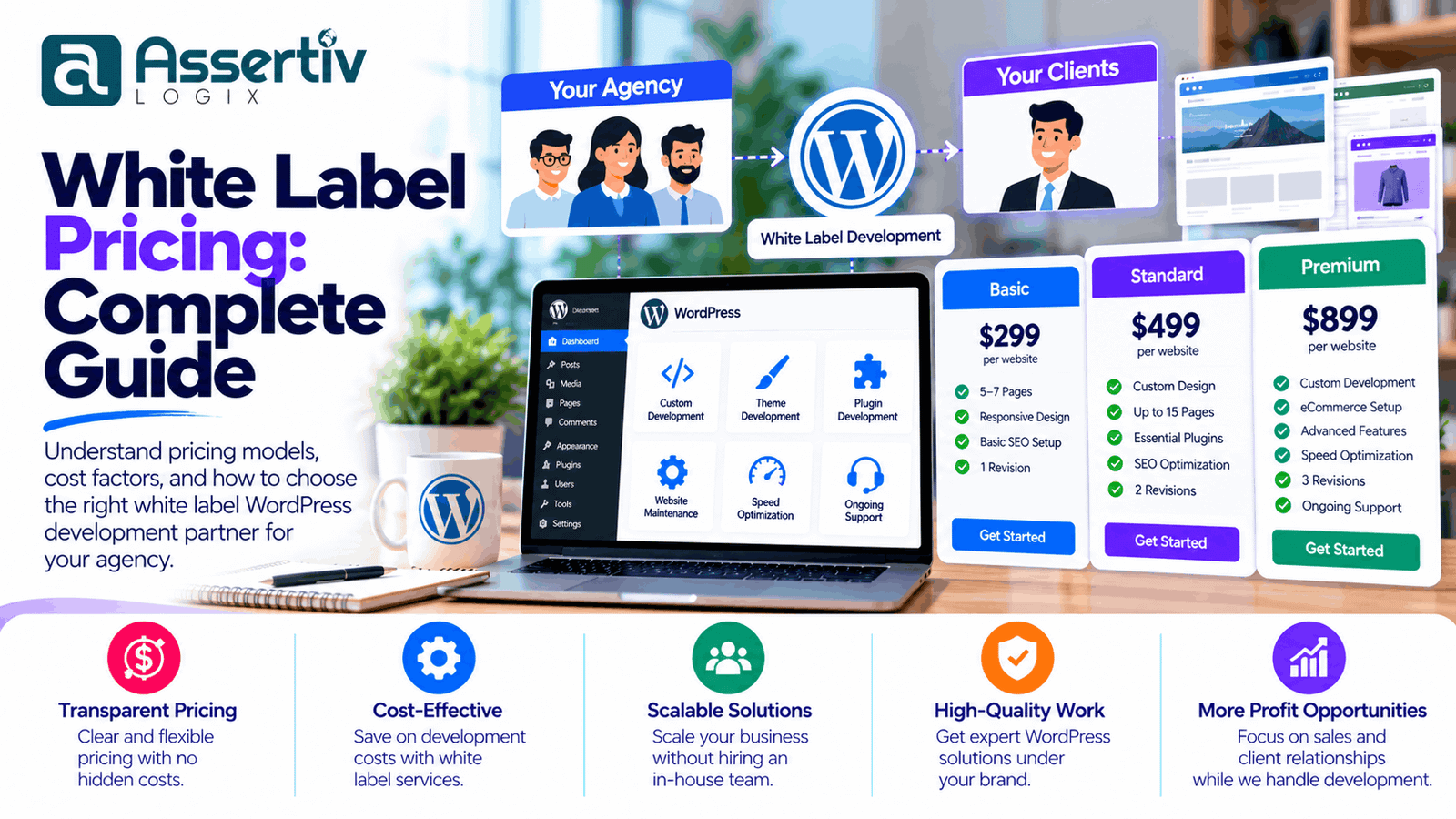
White label pricing determines how much an agency pays a third-party provider to deliver services that the agency sells under its own brand. It is an important consideration for digital marketing agencies, web design studios, freelancers, and WordPress development companies that want to expand their services without building every capability in-house.
For example, a web design agency may sell a WordPress website to a client but outsource the development to a white-label partner. The agency pays the partner for the agreed work, manages the client relationship, and charges its client a price that covers delivery costs, project management, overhead, risk, and profit.
The right pricing model depends on the service, project complexity, workload, delivery timeline, support requirements, and relationship between the agency and its provider. A low supplier quote does not automatically mean a profitable project, and a high markup does not guarantee a healthy margin.
This guide explains common white-label pricing models, the factors that influence costs, how agencies can calculate profitable client prices, and what to check before signing an agreement.
What Is White Label Pricing?
White label pricing is the amount a business pays a service provider to complete work that the business resells or delivers under its own brand.
The provider may handle the technical execution while the agency focuses on sales, strategy, customer relationships, and quality control. The agency typically sets the final price for its client, subject to the terms of its agreement with the provider.
White-label services can include:
- WordPress website design and development
- Custom WordPress themes and plugins
- WooCommerce store development
- Search engine optimization services
- Website maintenance and technical support
- Graphic design and creative production
- Content writing and digital marketing
- Software development and API integrations
The exact pricing structure differs by service. Some providers charge per project, others bill by the hour or month, and some offer packages with defined deliverables.
Common White Label Pricing Models
Choosing the right model is just as important as negotiating the price. A model that works for one-off websites may not be suitable for recurring maintenance or ongoing development work.
1. Fixed-Price Project Model
Under a fixed-price arrangement, the agency pays an agreed amount for a clearly defined scope of work.
For example, the provider might quote a fixed fee to build a five-page WordPress business website with a specified design, contact form, responsive layouts, and basic launch support.
Best for: Websites, landing pages, migrations, defined integrations, and other projects with clear deliverables.
Advantages:
- Easier to forecast project costs
- Simple to include in client proposals
- Clear payment milestones
- Less uncertainty when the scope remains stable
Potential drawbacks:
- Scope changes can increase the cost
- Unclear requirements can cause disputes
- Complex projects may need contingency allowances
Before agreeing to a fixed price, document the included pages, functionality, revisions, integrations, testing, and post-launch support. Define how additional requests will be quoted.
2. Hourly Pricing Model
With hourly pricing, the provider charges for the actual time spent on approved work.
This model can be useful when the scope is uncertain or when the agency needs ongoing access to a developer for bug fixes, troubleshooting, or incremental improvements.
Best for: Maintenance tasks, technical investigations, changing requirements, and ongoing development support.
The agency should clarify the hourly rate, minimum billing increments, time-tracking method, approval process, reporting frequency, and whether emergency work carries a different rate.
Hourly work can become difficult to budget when requirements keep changing. Set a budget cap or approval threshold when the client needs predictable spending.
3. Monthly Retainer Model
A monthly retainer provides an agreed level of service or development capacity for a recurring fee.
For example, an agency might reserve a set number of developer hours each month for website updates, small feature requests, troubleshooting, and maintenance.
Best for: Agencies with recurring clients, regular development requests, or ongoing website support commitments.
The contract should specify whether unused hours expire or roll over, how quickly requests are handled, whether work is prioritized, and how extra capacity is billed.
Do not assume a monthly retainer means unlimited development. Define the actual service level and workload.
4. Dedicated Developer Model
In a dedicated developer arrangement, the agency reserves a developer or development resource for an agreed period and capacity.
This can offer greater continuity than assigning separate tasks to different developers. It may also make collaboration easier when the agency has several active projects.
Best for: Agencies with steady workloads, ongoing client accounts, and frequent technical requirements.
Clarify working hours, availability, holidays, reporting, communication channels, exclusivity if applicable, and whether the arrangement includes project management or quality assurance.
5. Package-Based Pricing
Package pricing groups defined services into tiers. A WordPress provider, for example, might offer separate packages for basic website builds, advanced business websites, and WooCommerce stores.
Packages can simplify proposals and help agencies sell repeatable services. However, the packages need clearly stated limits.
Document the number of pages, included features, integrations, revision rounds, content responsibilities, delivery timeline, and exclusions. Quote unusual functionality separately instead of forcing every project into a standard package.
6. White Label Reseller Pricing
In a reseller arrangement, the provider offers services at an agreed wholesale or partner price. The agency sets its own retail price and manages the commercial relationship with its client.
This is a common structure for agencies that sell recurring website services or repeatable development packages.
The wholesale price is only one part of the calculation. The agency must also account for sales costs, project coordination, account management, quality assurance, payment fees, support, and the possibility of rework.
What Affects White Label Pricing?
There is no universal price for white-label services. Two projects with similar descriptions can have very different costs because their requirements and delivery risks are different.
Project Complexity
A brochure website with standard functionality generally requires a different level of effort from a custom platform with advanced user roles, dynamic content, third-party APIs, or specialized business logic.
The more complex the technical requirements, the more discovery, development, and testing may be needed.
Scope and Number of Deliverables
The number of pages, templates, integrations, products, custom features, and content items can affect the workload. A clearly defined scope allows the provider to estimate the work more accurately.
Design and Customization
A project using an approved design system or an existing theme may require less work than a completely custom design with interactive components and unique templates.
The cost also depends on whether the provider is responsible for design, development only, or both.
Developer Experience and Specialization
A provider with relevant experience in WooCommerce, custom plugin architecture, performance optimization, or complex integrations may charge differently from a generalist provider.
Compare the provider’s ability to deliver the required outcome, not just the quoted rate.
Turnaround Time
Urgent deadlines may require the provider to reprioritize work, allocate additional resources, or arrange out-of-hours support. Confirm whether rush work costs extra before promising a deadline to the client.
Testing and Quality Assurance
Browser testing, mobile checks, form validation, checkout testing, integration checks, accessibility considerations, security review, and performance testing all require time.
If these activities are excluded from the quote, the agency may need to pay for them separately or handle them internally.
Revisions and Scope Changes
Reasonable corrections to meet the agreed requirements should be distinguished from new features or changed design direction.
Agree on what counts as a defect, what counts as a revision, and how additional scope is approved and priced.
Ongoing Support
Maintenance, security updates, backups, troubleshooting, and post-launch assistance may be charged separately or included in a recurring package.
Always confirm the duration of included support, response targets, and the price of ongoing service.
White Label Pricing Examples
The following examples are illustrative calculations, not market-rate estimates or advertised Assertivlogix prices. Replace the figures with actual supplier quotes and your own operating costs before using them in a proposal.
Example 1: Fixed-Price Website Project
Suppose an agency receives a supplier quote of $1,200 for a defined WordPress website project.
The agency estimates another $250 for project management and quality assurance, and $100 for allocated overhead and risk.
Its total estimated delivery cost is:
| Cost component | Illustrative amount |
|---|---|
| White-label provider | $1,200 |
| Project management and QA | $250 |
| Allocated overhead and risk | $100 |
| Total estimated cost | $1,550 |
If the agency sells the project for $2,200, its estimated gross profit before other unallocated business expenses and taxes is $650.
The gross margin is:
[
\text{Gross margin}=\frac{\text{Selling price}-\text{Total delivery cost}}{\text{Selling price}}\times100
]
For this example:
[
\frac{2200-1550}{2200}\times100\approx29.5%
]
The agency should confirm that its cost estimate includes all material delivery expenses and that the remaining margin supports its business.
Example 2: Hourly Reselling
Suppose a white-label developer charges the agency $25 per hour, and the agency bills the client $45 per hour for the same approved development work.
The difference is $20 per billed hour before the agency’s additional expenses.
If the work takes 20 hours:
- Provider cost: $25 × 20 = $500
- Client revenue: $45 × 20 = $900
- Difference before additional costs: $400
That $400 is not necessarily net profit. The agency may still need to pay for project management, account management, software, payment processing, rework, and other overhead.
The agency should also ensure that the client’s agreement permits the proposed billing arrangement.
Example 3: Monthly Maintenance Retainer
Suppose an agency pays a provider $300 per month for an agreed maintenance service and allocates another $75 per month to coordination and overhead.
The estimated monthly cost is $375.
If the agency charges its client $550 per month, the difference is $175, or approximately 31.8% of revenue before other unallocated costs and taxes.
This model can work well when the scope is consistent and support demand is predictable. It becomes less attractive if the client regularly requests work beyond the agreed service level.
How to Calculate a Profitable White Label Price
A sustainable price should cover the provider’s fee and the agency’s own delivery expenses while leaving an appropriate margin.
Step 1: Calculate the Provider Cost
Start with the provider’s written quote. Confirm whether it includes development, testing, deployment, revisions, and documentation.
Step 2: Add Your Internal Costs
Include the time spent on discovery, client communication, project management, quality assurance, account management, and handover.
Step 3: Include Additional Expenses and Risk
Consider software licenses, payment fees, currency conversion, subcontractor expenses, likely rework, and a reasonable allowance for project uncertainty.
Do not add an arbitrary contingency without understanding the risk. Use past project data where available.
Step 4: Choose a Target Gross Margin
The appropriate margin depends on the service, sales costs, business overhead, risk, and competitive position. There is no single target that fits every agency.
To calculate a price from a target margin, use:
[
\text{Selling price}=\frac{\text{Total delivery cost}}{1-\text{Target gross margin}}
]
For example, if the total delivery cost is $1,500 and the target gross margin is 30%:
[
\frac{1500}{1-0.30}=$2,142.86
]
The agency would need to charge approximately $2,143 to achieve a 30% gross margin under these assumptions.
Step 5: Check the Scope and Commercial Terms
Before sending the proposal, confirm deliverables, payment milestones, revision limits, acceptance criteria, ownership, support, and change-request pricing.
The client price should reflect the value and responsibility the agency provides, not simply the supplier fee plus an arbitrary amount.
Markup vs. Gross Margin: What Is the Difference?
Markup and gross margin are related but measure different things.
Markup measures the profit added relative to cost.
[
\text{Markup}=\frac{\text{Selling price}-\text{Cost}}{\text{Cost}}\times100
]
Gross margin measures the difference relative to revenue.
[
\text{Gross margin}=\frac{\text{Selling price}-\text{Cost}}{\text{Selling price}}\times100
]
For example, if a project costs $1,000 and sells for $1,500:
- Gross profit: $500
- Markup: 50%
- Gross margin: 33.3%
An agency that confuses these figures may underprice work while believing it has achieved a higher margin. Use the same cost definition consistently when comparing projects.
How to Negotiate Better White Label Pricing
Negotiation should aim for a reliable commercial relationship, not just the lowest quote.
Provide Complete Requirements
Detailed briefs reduce uncertainty and help providers quote accurately. Include designs, functionality, integrations, content responsibilities, acceptance criteria, and deadlines.
Discuss Recurring Work
If your agency can offer a predictable volume of suitable work, ask whether the provider offers volume-based pricing or a recurring arrangement. Do not promise a volume you cannot reasonably deliver.
Agree on a Standard Workflow
Reusable templates, staging environments, code standards, handover checklists, and approval processes can reduce unnecessary work over time.
Separate Standard Work From Custom Requests
Ask for clearly priced options for standard services, advanced features, urgent requests, and ongoing support. This makes it easier to prepare client proposals and control scope.
Review Performance, Not Only Price
Track delivery reliability, defect rates, communication, revision frequency, and client satisfaction. A slightly more expensive provider may deliver better overall economics if less agency time is spent fixing issues.
Questions to Ask a White Label Provider Before Signing
Before committing to a partner, ask:
- What exactly is included in the quoted price?
- Are discovery, testing, revisions, deployment, and documentation included?
- How are additional features and scope changes priced?
- What are the payment terms and milestone requirements?
- How are urgent tasks and delayed approvals handled?
- Who owns the code, designs, and other deliverables after payment?
- What confidentiality and client-data protections are in place?
- What support is available after launch, and what does it cost?
- How will project status, risks, and blockers be communicated?
- Can we start with a small paid project before entering a longer agreement?
Record the answers in the statement of work or service agreement. Verbal assurances are not a substitute for clear commercial terms.
Common White Label Pricing Mistakes
Competing Only on the Lowest Price
The cheapest provider may not offer the testing, communication, or support needed for a reliable client experience. Evaluate total delivery cost and risk.
Ignoring Agency Labor
Even when development is outsourced, the agency still spends time on sales, requirements, approvals, project management, and client support. Leaving these costs out makes the project appear more profitable than it is.
Offering Unlimited Revisions
Unlimited revisions can make fixed-price work unprofitable. Define a reasonable revision process and charge for new requirements or changes outside the agreed scope.
Underestimating Ongoing Support
A website may require post-launch fixes, updates, and troubleshooting. Specify what is included, how long support lasts, and what recurring maintenance costs.
Applying the Same Margin to Every Service
Different services have different levels of complexity, competition, delivery risk, and account-management effort. Price each service according to its actual economics.
Failing to Review Profitability
After each project, compare the original estimate with actual provider fees, agency hours, rework, and support costs. Use this information to improve future quotes.
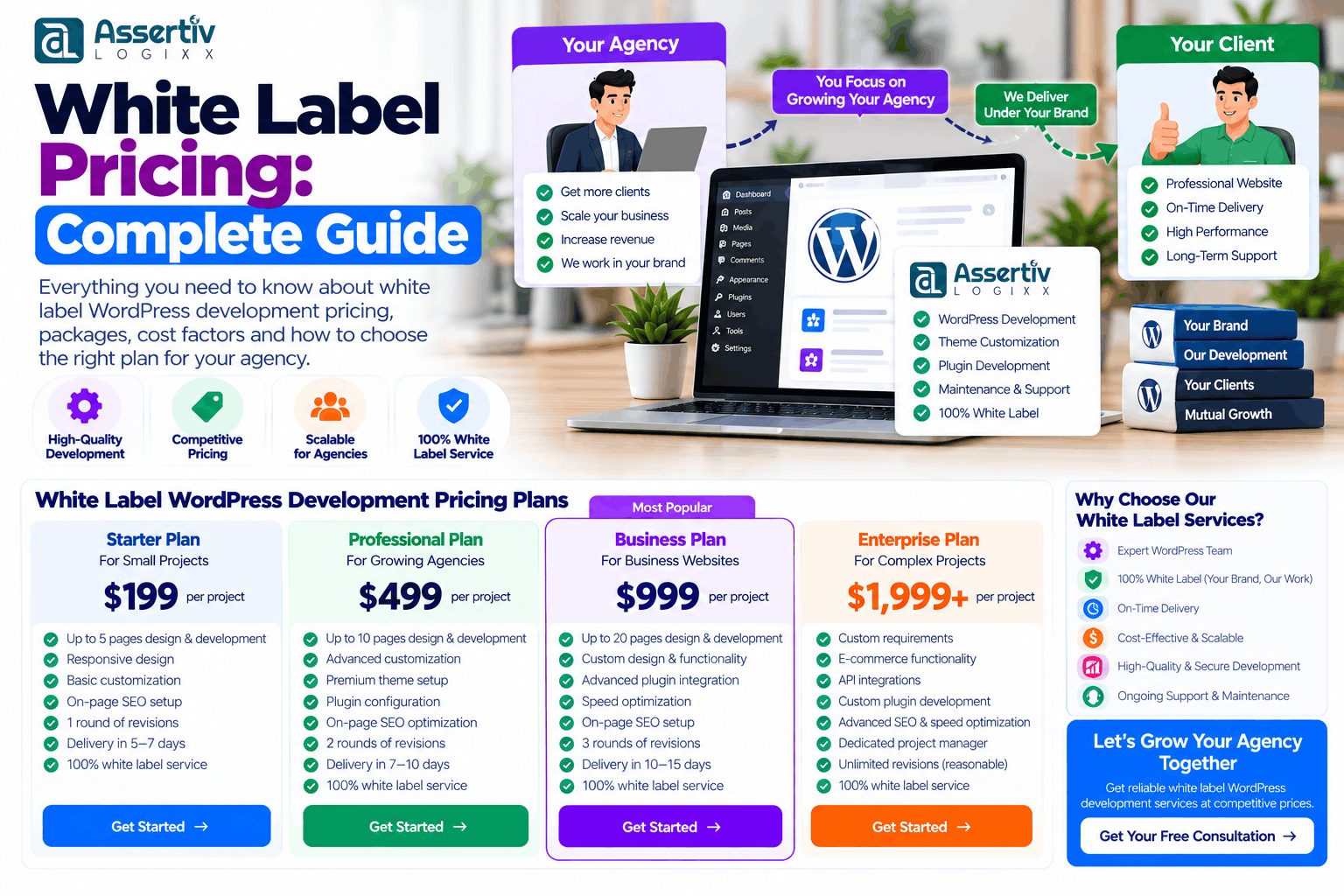
How Assertivlogix Can Help With White Label WordPress Projects
Assertivlogix provides WordPress and WooCommerce development services for businesses that need technical implementation and website support. Agencies can discuss their project requirements, scope, timelines, and potential working arrangements with the team.
Depending on the project, support may include custom WordPress website development, theme and plugin development, WooCommerce customization, API integrations, migrations, and performance optimization.
The most useful starting point is a clearly defined brief that identifies the required functionality, deliverables, timeline, testing needs, and ongoing support expectations. These details help both parties assess the project and establish an appropriate quote.
Visit Assertivlogix to explore the company’s services or contact the team to discuss your requirements.
<div class=”blog_cta_wrap”> <span>Looking for a white-label WordPress development partner?</span> <p>Share your project scope with Assertivlogix to discuss technical requirements, delivery expectations, and a suitable pricing arrangement.</p> <p><a id=”talk_to_expert” class=”btn button” href=”https://www.assertivlogix.com/contact/“>Get Your Free Consultation</a></p> </div>
Frequently Asked Questions
What is white label pricing?
White label pricing is the fee a business pays a third-party provider to deliver services that the business resells or presents under its own brand. Pricing can be project-based, hourly, monthly, or package-based.
How much does white label WordPress development cost?
The cost depends on project scope, design complexity, custom functionality, integrations, testing, delivery time, and support. Request a quote based on documented requirements rather than relying on a single generic price.
How do agencies make money from white label services?
Agencies charge clients for the complete service and account for provider fees, internal labor, overhead, risk, and profit. The amount remaining after delivery costs is the gross profit before other unallocated expenses and taxes.
What is the difference between markup and gross margin?
Markup calculates the price increase relative to cost, while gross margin calculates gross profit as a percentage of revenue. A 50% markup does not equal a 50% gross margin.
Which white label pricing model is best?
Fixed-price projects work well when deliverables are clear. Hourly billing suits uncertain or changing work, while monthly retainers and dedicated developer arrangements can suit agencies with recurring demand. The best model depends on workload and service requirements.
Should white label pricing include maintenance and support?
Only if those services are explicitly included in the agreement. Define the duration of included support, response expectations, maintenance tasks, and charges for work outside the agreed scope.
How can an agency protect its white label profit margin?
Calculate total delivery costs, include internal agency labor, define scope and revisions, manage change requests, negotiate clear supplier terms, and compare estimated costs with actual project results.
Conclusion
White label pricing is not simply the amount a provider charges for development. A sustainable pricing model accounts for the work itself, the agency’s time, delivery risk, quality assurance, client management, and ongoing support.
By selecting the right pricing structure, defining scope clearly, understanding markup and gross margin, and reviewing actual project performance, agencies can make better commercial decisions and build more dependable white-label partnerships.