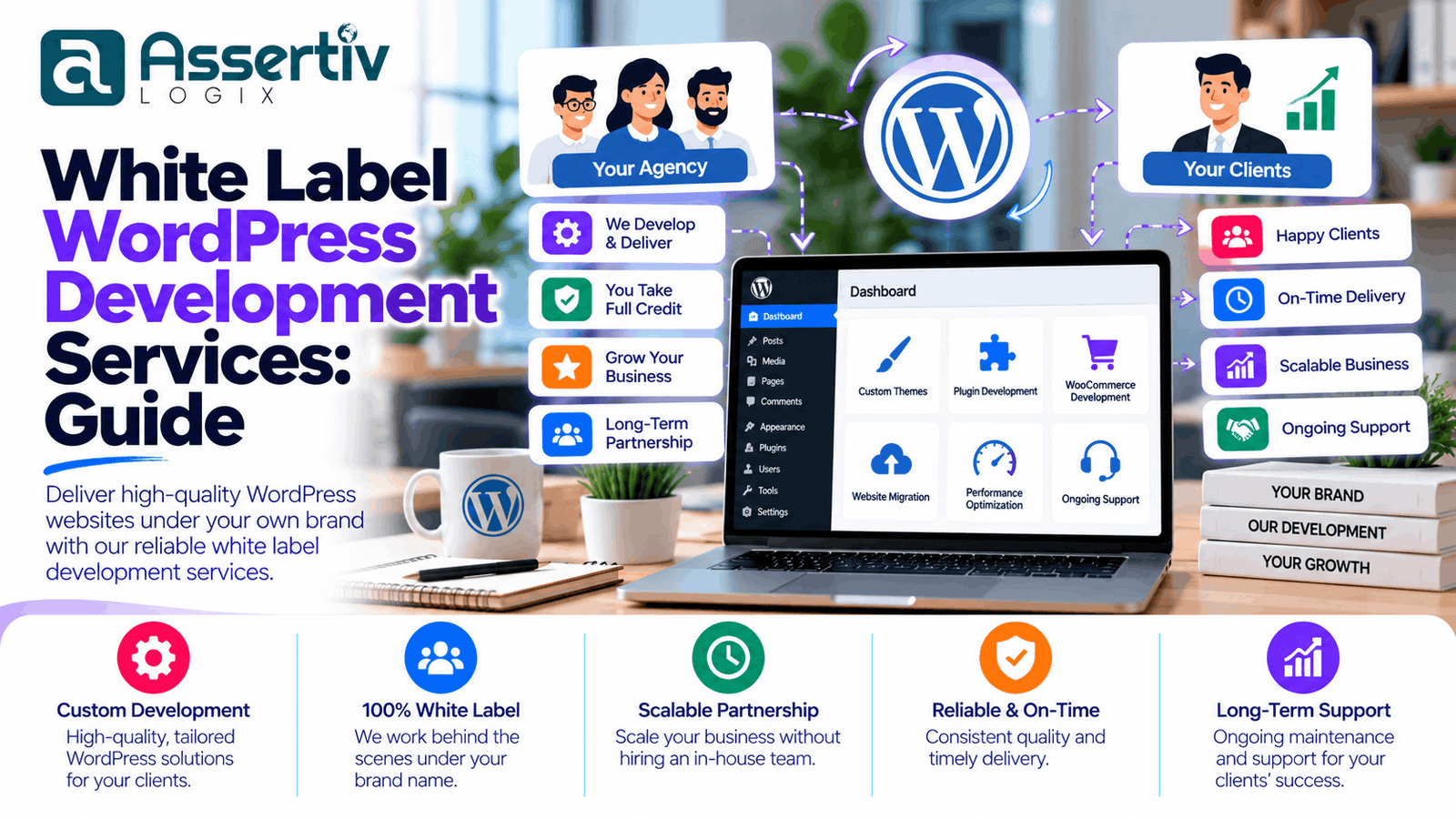
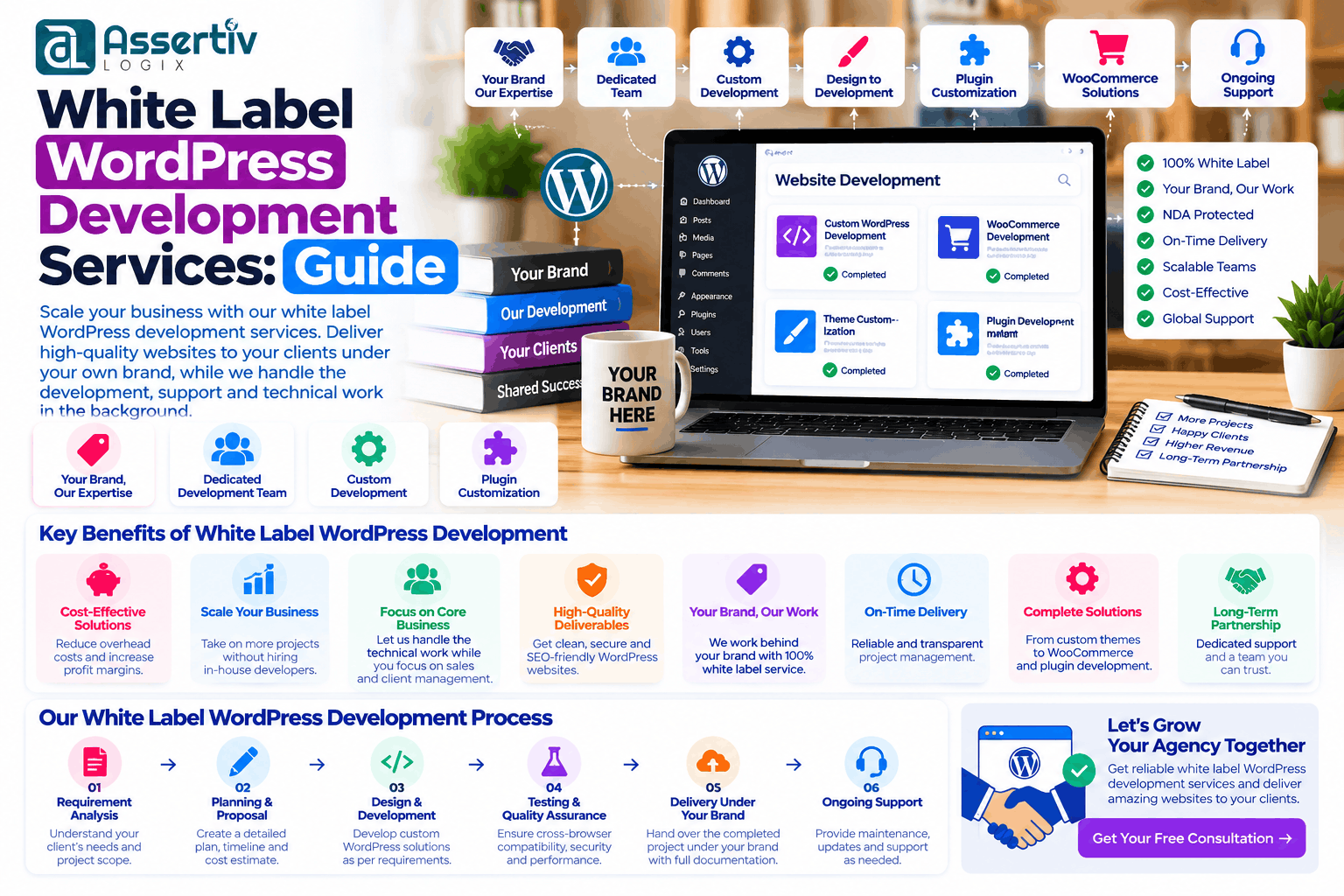
White label WordPress development services help digital agencies, marketing companies, design studios, and freelancers deliver WordPress websites under their own brand without building every project with an in-house development team. A specialist partner handles the technical work, while the agency manages the client relationship and presents the finished project as part of its own service offering.
This model can help agencies take on more projects, offer services they cannot currently deliver, and manage fluctuations in workload without hiring a full-time development team for every new requirement. It can also create challenges if responsibilities, communication, quality standards, and client confidentiality are not clearly defined.
Choosing the right white label WordPress development partner requires more than comparing hourly rates. You need a team that understands your workflows, follows your quality standards, protects client information, and delivers work that your agency can confidently put its name on.
This guide explains how white label WordPress development works, what services you can outsource, how to choose a partner, which pricing factors matter, and how to build a productive long-term relationship.
What Are White Label WordPress Development Services?
White label WordPress development services allow one company to provide WordPress development work that another company sells under its own brand. The delivery partner performs the agreed technical tasks, while the agency remains the primary point of contact for its client, according to the partnership arrangement.
For example, a branding agency may design a website for a client but lack the developers needed to build a custom WordPress theme. The agency can work with a white label development partner to implement the design, configure WordPress, test the website, and deliver the completed project under the agency’s brand.
The arrangement can cover a single project, recurring development work, ongoing maintenance, or a dedicated team that supports multiple client accounts.
Common characteristics of a white label arrangement include:
- The agency owns or manages the client relationship.
- The development partner works according to the agreed scope and delivery process.
- Project communication and branding are handled according to the partnership agreement.
- Client-facing deliverables can use the agency’s branding where agreed.
- Confidentiality, intellectual property, access, and payment terms are documented.
- The agency remains responsible for the promises it makes to its own client.
White labeling is not simply outsourcing code. It is a delivery model designed to help agencies expand their service capacity while maintaining a consistent client experience.
How Does White Label WordPress Development Work?
A successful partnership starts with clear ownership and a repeatable process. The agency should know what it is selling, the development partner should understand what it must deliver, and the client should receive a coordinated service experience.
- The agency identifies the project: A client needs a new website, redesign, custom feature, WooCommerce store, or ongoing support.
- The requirements are documented: The agency shares the scope, design files, functionality, content, integrations, deadlines, and acceptance criteria.
- The partner estimates the work: The development team reviews the requirements, identifies dependencies, and provides a timeline and cost estimate.
- The agency approves the scope: Both parties agree on deliverables, milestones, responsibilities, revision limits, and communication procedures.
- Development begins: The partner builds the website or feature using the agreed tools, coding standards, and staging workflow.
- The agency reviews progress: The agency checks milestones and shares consolidated feedback or requests revisions within the agreed scope.
- Quality assurance is completed: The website is tested for functionality, responsive behavior, compatibility, performance, and security requirements.
- The project is delivered: The agency presents the approved work to its client and coordinates launch or handover.
- Ongoing support is arranged: Maintenance, bug fixes, future enhancements, and support responsibilities are handled according to the agreement.
The exact workflow varies by agency. Some partners communicate directly with the agency’s client under the agency’s brand, while others work exclusively behind the scenes. Agree on this arrangement before development starts.
What Services Can Agencies Outsource?
White label WordPress development can support much more than standard business websites. Agencies can outsource individual technical tasks or the full implementation of a project, depending on the skills and processes of the partner.
1. Custom WordPress website development
A white label partner can turn approved designs and requirements into a functional WordPress website. This may include page templates, navigation, reusable components, custom content structures, forms, and responsive layouts.
This service is useful for branding studios and marketing agencies that sell website design but want a specialist team to handle implementation.
2. Custom theme development
Some projects require a theme tailored to the client’s design system and content needs. A development partner can build custom templates, reusable blocks, theme functionality, and editor experiences instead of relying entirely on a prebuilt theme.
Agencies should define accessibility, responsive behavior, browser support, maintainability, and performance expectations before development begins.
3. WordPress plugin development
Custom plugins can add functionality that standard extensions do not provide. Examples include specialized forms, business dashboards, custom post-processing workflows, external API connections, and features tied to a client’s internal systems.
For projects that need bespoke functionality, agencies can explore WordPress plugin development services as part of their technical delivery plan.
4. WooCommerce development
White label WooCommerce development can help agencies deliver online stores, custom product pages, checkout enhancements, payment integrations, shipping rules, and store management workflows.
Projects may also involve product data migration, inventory synchronization, subscriptions, wholesale functionality, or integrations with CRM and accounting platforms. These requirements should be scoped carefully because they can affect testing effort and delivery timelines.
Learn more about WooCommerce development services.
5. Website redesign and migration
An agency may need to move a website from another CMS, rebuild an outdated WordPress site, or modernize an existing design. A white label partner can assist with content migration, template redevelopment, redirects, functionality checks, and launch preparation.
Migration projects should include a clear plan for URLs, SEO metadata, forms, analytics, customer data where applicable, and post-launch monitoring.
6. Speed optimization and technical improvements
Agencies can outsource performance audits, image optimization, caching configuration, Core Web Vitals improvements, database investigation, and frontend optimization. Changes should be tested carefully so they do not break forms, shopping carts, checkout, or other critical functionality.
7. WordPress maintenance and support
Recurring support may include updates, backups, uptime checks, troubleshooting, compatibility testing, security reviews, and small improvements. A white label maintenance arrangement can help agencies offer ongoing website care without managing every technical task internally.
Define exactly what is included in the support plan, how urgent issues are handled, and whether development work beyond routine maintenance is billed separately.
8. API integrations and custom functionality
Some websites need to connect WordPress with CRMs, payment providers, inventory systems, marketing platforms, booking tools, or other business applications. A development partner can implement the required API integration and handle data mapping, error handling, authentication, and testing.
Integration scope should include what happens when an external service is unavailable, data is invalid, or synchronization fails.
Who Should Use White Label WordPress Development?
Digital marketing agencies
Marketing agencies often need landing pages, campaign microsites, website updates, conversion improvements, and ongoing technical support. A white label partner can provide implementation capacity while the agency focuses on strategy, campaigns, and client relationships.
Web design and branding studios
Design studios can concentrate on user experience, visual identity, and design systems while outsourcing complex WordPress implementation. This arrangement can help them offer complete website projects without hiring developers for every skill set.
SEO agencies
SEO agencies may need technical website changes, structured data implementation, page speed improvements, template updates, and content management enhancements. A development partner can help implement approved recommendations while the agency handles SEO strategy and reporting.
Freelance designers and consultants
Independent professionals can use white label development to accept projects that require coding or technical skills beyond their own capacity. The key is to maintain enough project oversight to validate deliverables before presenting them to the client.
Established web development agencies
Agencies with internal developers can use white label support to manage temporary workload spikes, specialist requirements, or projects with tight deadlines. This can be more flexible than immediately expanding permanent headcount.
Benefits of White Label WordPress Development Services
1. Expand services without hiring a full team
Building an in-house team requires recruitment, onboarding, management, equipment, and ongoing salary commitments. A white label partnership gives an agency access to additional development capacity without necessarily taking on all these fixed costs.
The arrangement still requires budget for development work and project management, but the cost structure may be more flexible.
2. Scale delivery capacity
Project demand can fluctuate. An agency may have several website launches in one month and fewer development requirements the next. An external partner can help absorb some of these changes, provided capacity and availability are agreed in advance.
Do not assume a partner can accept unlimited work immediately. Confirm the team’s current workload, delivery capacity, and backup arrangements.
3. Access specialist skills
One agency may be strong in design and SEO but need support with WooCommerce, custom plugin development, API integrations, or advanced performance work. A specialist partner can fill these gaps without requiring the agency to develop every capability internally.
4. Focus on sales and client relationships
When development delivery is handled through a dependable process, the agency can devote more time to winning business, understanding client needs, and planning future services. The agency should still retain oversight of scope, communication, quality, and client satisfaction.
5. Build recurring revenue
Website projects often lead to ongoing needs such as maintenance, feature development, performance improvements, and support. Agencies can build recurring service offerings around these requirements and use a white label partner to support delivery.
Recurring revenue depends on clear service boundaries, reliable delivery, fair pricing, and continued client value. It should not be treated as guaranteed income.
6. Reduce delivery bottlenecks
When internal developers are busy with complex projects, routine updates or additional builds can delay other work. A white label partner can take on defined tasks and help keep projects moving, provided requirements and review processes are clear.
White Label Development vs. In-House Development
Neither model is automatically better. The right choice depends on project volume, technical complexity, desired control, available budget, and the agency’s long-term strategy.
| Factor | White label partner | In-house team |
|---|---|---|
| Initial commitment | Can begin with a defined project or service arrangement | Usually requires hiring and onboarding investment |
| Capacity flexibility | Can scale with agreed partner availability | Depends on team size and workload |
| Specialist skills | Can provide access to skills the agency lacks | Requires recruiting or training for missing skills |
| Direct oversight | Requires a clear review and communication process | Often offers more immediate day-to-day control |
| Knowledge retention | Requires documentation and handover planning | Knowledge can remain within the organization |
| Cost structure | Typically tied to agreed projects or service plans | Includes salaries and other employment overheads |
| Best fit | Variable demand or specialist capacity gaps | Consistent workload requiring continuous internal ownership |
Many agencies use a hybrid approach: internal staff manage strategy, design, architecture, and client communication, while external specialists support defined development tasks.
How Much Do White Label WordPress Development Services Cost?
Pricing depends on the type of work, project scope, technical complexity, communication requirements, quality assurance, and support expectations. A simple content page is very different from a custom WooCommerce store or a plugin that integrates multiple external systems.
| Pricing model | How it works | Best suited for |
|---|---|---|
| Hourly | The agency pays for approved development time | Uncertain requirements, troubleshooting, and small enhancements |
| Fixed project | Price is agreed for a defined scope and deliverables | Projects with clear specifications and acceptance criteria |
| Monthly capacity | The agency reserves an agreed amount of development capacity | Recurring client work and predictable ongoing demand |
| Maintenance plan | A recurring fee covers specified support and maintenance tasks | Ongoing website care and routine technical support |
Before comparing proposals, check what is included in the price. Some estimates may exclude project management, testing, premium plugins, hosting, migration, revisions, or post-launch support.
Ask for a written estimate that defines:
- Included deliverables and excluded work
- Estimated timeline and milestone dates
- Revision limits and approval responsibilities
- Third-party licenses and other recurring costs
- Testing and quality assurance scope
- Bug-fix period and ongoing support terms
- Ownership of code, designs, and project assets
- Payment terms and procedures for scope changes
Choose a pricing model that matches the certainty of your requirements. Fixed pricing can help with budgeting when the scope is clear, while hourly or capacity-based arrangements can be more suitable when requirements are likely to evolve.
How to Choose a White Label WordPress Development Partner
1. Review relevant technical experience
Look for experience that matches the projects you intend to outsource. If your agency sells WooCommerce stores, ask about product types, checkout customization, payment integrations, order workflows, and testing. If you build custom WordPress sites, review the partner’s approach to themes, plugins, content structures, and maintainable code.
Ask for relevant work samples and clarify the team’s role in each example. Do not rely only on generic claims about expertise.
2. Evaluate communication and project management
White label delivery requires consistent communication between the agency and development team. Agree on the primary contact, response expectations, meeting schedule, progress updates, escalation process, and format for sharing feedback.
Ask how the partner manages overlapping deadlines, blocked tasks, and changes to requirements. A clear process is often more valuable than frequent but unstructured status messages.
3. Check quality assurance practices
Ask how the team tests responsive layouts, forms, browsers, integrations, accessibility requirements, performance, and security. For WooCommerce projects, confirm that checkout, payment status, inventory, shipping, taxes, and refunds are included in the testing plan where applicable.
Make sure the agency has time and responsibility allocated for its own final review before delivery to the client.
4. Confirm white label confidentiality
If the partner is expected to remain behind the scenes, define how this works in practice. The agreement should cover client contact, use of logos, portfolio rights, case studies, public references, subcontracting, and disclosure of the relationship.
Use appropriate confidentiality terms and avoid sharing client information beyond what is necessary for the work. Provide role-based access to websites, hosting, repositories, and other systems.
5. Clarify code and intellectual property ownership
Document who owns the final code, designs, documentation, and other deliverables after payment. Identify any pre-existing tools, third-party libraries, open-source components, and licensed plugins that are not transferred as exclusive property.
For commercial projects, the agreement should explain the permitted use and transfer of deliverables and account for relevant third-party license terms.
6. Start with a pilot project
Before committing a large portfolio of client work, assign a small project with a clear scope and deadline. Evaluate communication, technical quality, documentation, revision handling, and how well the partner follows your agency’s process.
Use the pilot to identify process improvements and decide whether the partnership is suitable for larger projects.
7. Check availability and continuity
Ask how the partner handles staff absence, workload spikes, urgent fixes, and handovers. A reliable arrangement should not depend entirely on one person having undocumented knowledge of a client’s website.
Documentation, source control, backups, and a defined handover procedure help protect both the agency and its client.
Best Practices for a Successful White Label Partnership
- Write a clear brief: Include designs, functionality, content requirements, integrations, and acceptance criteria.
- Agree on scope before development: Document how new requests and revisions will be estimated.
- Use staging environments: Test changes before deploying them to live client websites.
- Keep work in source control: Use an agreed repository and access policy for code and configuration.
- Set quality standards: Define responsive behavior, accessibility expectations, performance, security, and browser support.
- Protect client access: Use individual accounts, least-privilege permissions, and secure credential handling.
- Maintain documentation: Record deployment steps, custom functionality, integrations, and known limitations.
- Consolidate feedback: Have the agency review work internally before sending revision requests.
- Plan for launch: Define backups, deployment responsibilities, DNS changes, redirects, and rollback procedures where needed.
- Review the relationship regularly: Track delivery reliability, rework, communication quality, and client satisfaction.
Common White Label Development Mistakes to Avoid
Choosing a partner based only on price
A low quote may exclude testing, documentation, project coordination, or post-launch support. Compare the complete scope and delivery process rather than the headline rate alone.
Sharing incomplete requirements
Missing designs, unclear acceptance criteria, and undocumented integrations can create repeated revisions and disputes. Clarify the expected behavior before development starts, and use a change-control process when requirements evolve.
Making promises before confirming capacity
An agency should not commit to a delivery date until it has checked the scope, dependencies, and partner availability. Build realistic review time into the project schedule.
Allowing client communication to become unclear
If both the agency and the developer communicate separately with the client without agreed responsibilities, requests can become inconsistent. Define who approves decisions and who communicates changes.
Ignoring maintenance and ownership
Delivery is only one part of the website lifecycle. Clarify who handles updates, future development, bug reports, hosting access, and handover documentation once the project is complete.
Why Agencies Consider Assertivlogix for White Label WordPress Development
Assertivlogix provides WordPress and WooCommerce development services that agencies can consider when they need additional technical delivery capacity. Depending on project requirements, support may include custom websites, theme and plugin development, eCommerce functionality, API integrations, migration, performance optimization, and maintenance.
A productive white label arrangement should start with a clear project scope, agreed communication rules, delivery milestones, and quality expectations. Agencies should be able to review work before client handover and understand how support will be handled after launch.
If you are evaluating a development partner, share the type of projects you handle, your preferred workflow, expected workload, and any confidentiality or client communication requirements. This makes it easier to assess whether the working model fits your agency.
Explore our WooCommerce development services and WordPress plugin development services to see the technical capabilities relevant to your projects.
Looking for a development partner to support your agency’s WordPress or WooCommerce projects? Discuss your workflow, technical requirements, and white label delivery expectations with Assertivlogix.
Frequently Asked Questions
What are white label WordPress development services?
White label WordPress development services allow an agency or consultant to outsource WordPress development to a specialist partner and deliver the completed work under its own brand, according to an agreed arrangement.
Who should use white label WordPress development?
Digital marketing agencies, web design studios, SEO companies, freelancers, and established development agencies can use white label development when they need additional capacity or specialist skills without building every capability internally.
What can a white label WordPress developer do?
A white label developer may build WordPress websites, custom themes, plugins, WooCommerce stores, API integrations, migrations, performance improvements, and maintenance solutions. The exact scope depends on the partner’s skills and the agreement.
How much do white label WordPress development services cost?
Pricing depends on scope, complexity, delivery timelines, testing requirements, and support expectations. Common models include hourly billing, fixed project pricing, monthly development capacity, and recurring maintenance plans.
Will my clients know I use a white label development partner?
That depends on the arrangement and the agreements with your clients and development partner. If the partner is expected to remain behind the scenes, document confidentiality, communication, branding, and disclosure expectations clearly.
How do I choose the right white label WordPress agency?
Review relevant technical experience, communication processes, quality assurance, confidentiality practices, ownership terms, availability, and support arrangements. Starting with a small pilot project can help you evaluate the partnership before committing to larger projects.
Can white label developers handle WooCommerce projects?
Yes, a suitably experienced partner can support WooCommerce stores, custom product functionality, checkout improvements, payment integrations, and other eCommerce work. Confirm experience with your specific requirements and agree on a detailed testing plan.
Is white label WordPress development better than hiring in-house developers?
It depends on your workload, budget, and need for direct control. White label development can offer flexibility and access to specialist skills, while an in-house team may be better for consistent workloads that require continuous internal ownership. Some agencies use both models.
Conclusion
White label WordPress development services can help agencies expand their capabilities, manage variable workloads, and deliver more technical projects without building every skill in-house. The model works best when the agency and development partner agree on scope, communication, confidentiality, quality standards, ownership, and ongoing support.
Before selecting a partner, review relevant experience, run a pilot project, and document the delivery process. Treat white label development as a long-term operating relationship rather than simply a way to purchase development hours.
If your agency needs support with WordPress websites, custom plugins, WooCommerce stores, or ongoing technical delivery, contact Assertivlogix to discuss your requirements.