
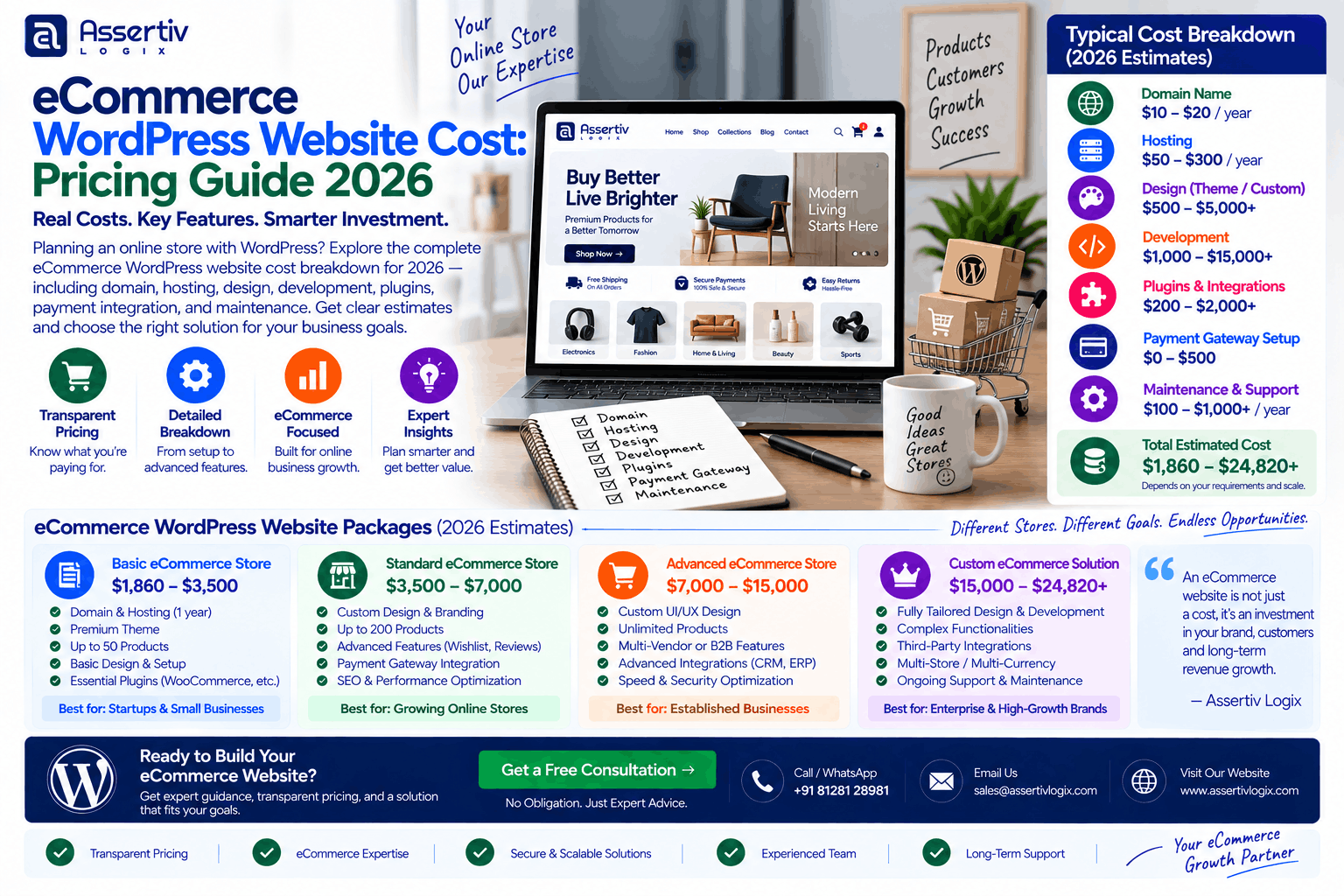
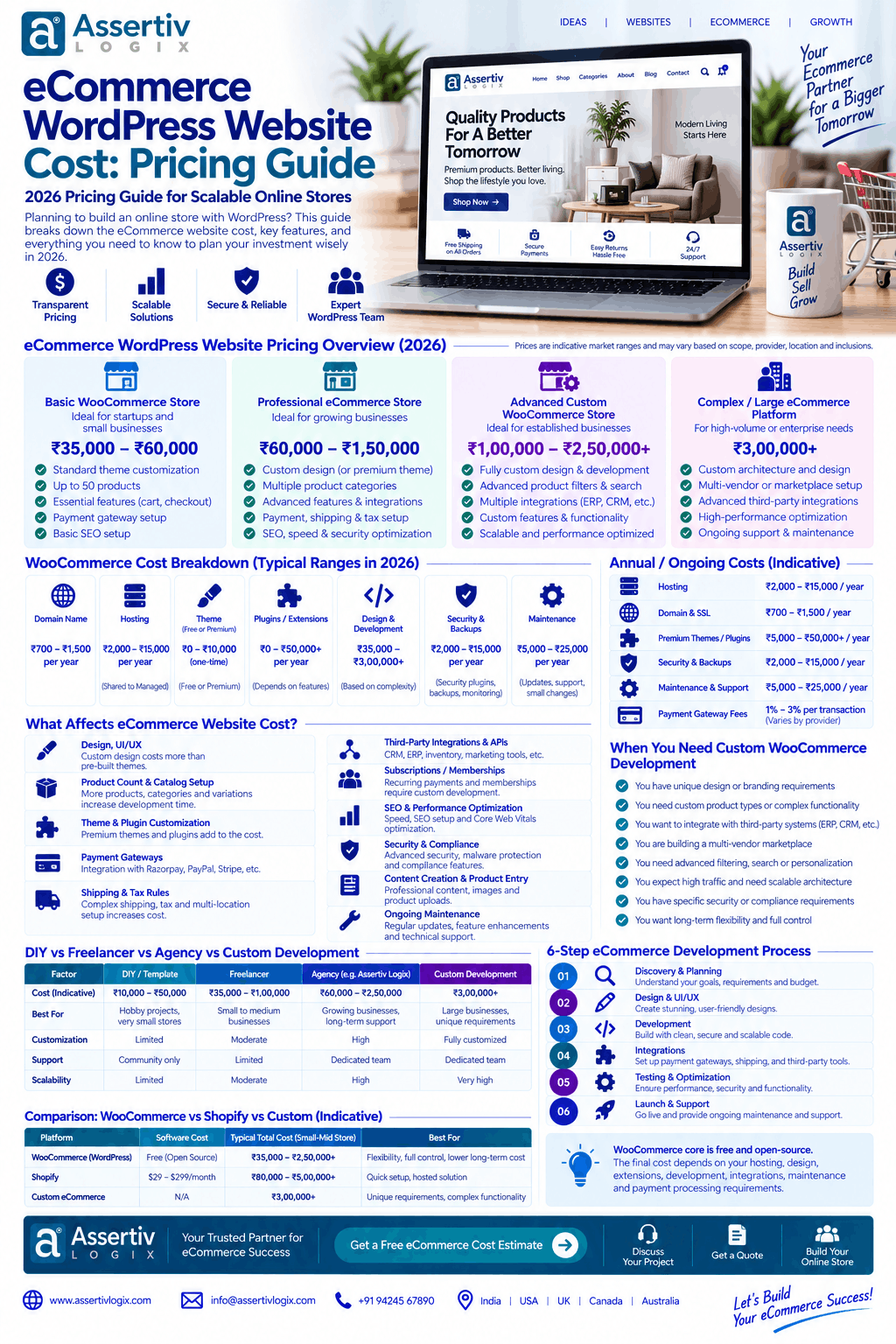
eCommerce WordPress website cost can range from a few hundred dollars for a basic online store to $10,000 or more for a highly customized WooCommerce website. The final price depends on the number of products, design requirements, payment gateways, shipping rules, integrations, custom functionality, performance requirements, and ongoing maintenance.
WordPress combined with WooCommerce gives businesses considerable flexibility. You can start with a relatively simple store and add features as your sales grow. However, the cost of building an online store is not limited to installing WooCommerce.
In this guide, we will break down the ecommerce WordPress website cost in 2026, including domain, hosting, design, development, WooCommerce, themes, plugins, payment gateways, product setup, SEO, security, maintenance, and hidden costs.
How Much Does an eCommerce WordPress Website Cost?
A professionally developed WordPress eCommerce website can typically cost between $1,500 and $10,000+, depending on complexity.
| eCommerce Website Type | Typical Cost | Suitable For |
|---|---|---|
| Basic DIY WooCommerce Store | $300–$1,000+ | Small catalogs and startups |
| Basic Professional Store | $1,500–$3,000 | Small businesses |
| Custom WooCommerce Store | $3,000–$7,500 | Growing online businesses |
| Advanced eCommerce Website | $7,500–$15,000+ | Complex business requirements |
| Enterprise WooCommerce Development | $15,000+ | Large catalogs and advanced integrations |
These are general planning ranges rather than fixed market prices. Your actual WordPress ecommerce website cost should be based on the features and business processes your store needs.
What Is Included in eCommerce WordPress Website Cost?
The total ecommerce WordPress website cost usually consists of several separate expenses.
- Domain name
- Web hosting
- SSL certificate
- WordPress setup
- WooCommerce configuration
- Website design
- WordPress theme
- WooCommerce extensions
- Custom development
- Product setup
- Payment gateway integration
- Shipping configuration
- Tax configuration
- SEO
- Security
- Performance optimization
- Maintenance and support
Some development agencies bundle these services into a single project price, while others charge separately for infrastructure, licenses, and ongoing support.
1. Domain Name Cost
Your domain is the address customers use to access your store.
A standard .com domain commonly costs around $10–$30 per year, although premium domains can cost much more.
When comparing domain providers, pay attention to both the introductory price and renewal price. A domain may be inexpensive during the first year but have a higher recurring renewal fee.
For information about WordPress and its ecosystem, visit WordPress.org.
2. eCommerce Hosting Cost
Hosting is one of the most important infrastructure expenses when calculating the ecommerce WordPress website cost.
An online store generally has more requirements than a simple brochure website because it needs to handle product images, customer sessions, carts, checkout requests, orders, payment processing, and database queries.
| Hosting Type | Typical Monthly Cost | Best For |
|---|---|---|
| Shared Hosting | $5–$20 | Small stores |
| Managed WordPress Hosting | $20–$75+ | Growing WooCommerce stores |
| VPS/Cloud Hosting | $30–$150+ | Higher-traffic stores |
| Dedicated Infrastructure | $100–$500+ | Large stores and complex workloads |
The correct hosting environment depends on traffic, product count, order volume, database size, integrations, and performance requirements.
3. WooCommerce Cost
WooCommerce is an open-source eCommerce platform built for WordPress. The core software can be used without purchasing a standard software license, but many stores require paid extensions or professional development.
Common additional WooCommerce expenses include:
- Payment gateway extensions
- Shipping extensions
- Subscription functionality
- Membership functionality
- Product add-ons
- Advanced reporting
- Marketing integrations
- CRM integrations
- Tax tools
The official WooCommerce documentation is a useful starting point when planning store functionality.
4. eCommerce Website Design Cost
Design has a major influence on the overall ecommerce WordPress website cost.
A store can use an existing WooCommerce-compatible theme, customize a premium theme, or use a completely custom design.
| Design Approach | Approximate Cost |
|---|---|
| Free Theme | $0 |
| Premium Theme | $50–$200+ |
| Theme Customization | $500–$2,500+ |
| Custom eCommerce UI/UX | $1,500–$5,000+ |
eCommerce design involves more than the homepage. Important screens include product pages, category pages, search results, cart, checkout, account pages, order pages, and transactional emails.
5. WooCommerce Development Cost
Development is often the largest part of the WordPress ecommerce website cost.
A developer may need to configure WooCommerce, create templates, customize checkout, implement business rules, integrate external services, and test the complete purchasing process.
Basic development may include:
- WooCommerce installation
- Store configuration
- Product categories
- Product pages
- Cart configuration
- Checkout configuration
- Customer accounts
- Order emails
Custom stores may additionally require:
- Custom product configurators
- Custom checkout fields
- Advanced product filters
- Custom pricing rules
- Wholesale pricing
- Subscription products
- Membership systems
- Customer dashboards
- Custom order workflows
- Third-party API integrations
6. Payment Gateway Integration Cost
A customer needs a convenient and secure way to pay for an order.
Depending on the target market, an online store may support credit cards, debit cards, bank transfers, wallets, local payment methods, or other payment providers.
Payment-related costs can include:
- Gateway setup
- WooCommerce gateway extensions
- Developer integration
- Transaction fees
- Currency conversion fees
- Recurring payment fees
Payment processing fees are usually separate from the website development budget, so they should be included when calculating the long-term cost of running an online store.
7. Product Upload and Catalog Setup
The number and complexity of products can have a significant impact on the project budget.
| Product Catalog | Potential Development Effort |
|---|---|
| 1–25 products | Low |
| 25–100 products | Low to moderate |
| 100–500 products | Moderate |
| 500+ products | Moderate to high |
Product setup becomes more complicated when products have multiple variations, attributes, downloadable files, custom pricing, product bundles, or complicated inventory rules.
If products already exist in another platform, importing the catalog can also require additional development or data cleanup.
8. Shipping Configuration Cost
Shipping requirements can range from a simple flat-rate fee to highly customized shipping calculations.
A store may need:
- Flat-rate shipping
- Free shipping thresholds
- Local pickup
- Zone-based shipping
- Weight-based shipping
- Product-specific shipping
- Courier integrations
- Real-time shipping rates
The more complicated the shipping rules, the more development and testing may be required.
9. Tax Configuration
Online stores may need different tax rules depending on where the business operates and where customers are located.
Tax configuration can become particularly complicated when selling across multiple states, countries, or tax jurisdictions.
Businesses should confirm tax requirements with their accountant or tax professional rather than relying solely on website settings.
10. eCommerce SEO Cost
SEO is especially important for online stores because search engines can send customers directly to category and product pages.
eCommerce SEO may include:
- Keyword research
- Category optimization
- Product page optimization
- Title and meta description optimization
- Internal linking
- Schema markup
- XML sitemap configuration
- Image optimization
- Technical SEO
- Site architecture
- Content marketing
Google’s SEO Starter Guide provides guidance on creating search-friendly websites.
For larger stores, SEO should be considered during the architecture and development stages rather than added after launch.
11. eCommerce Website Security Cost
Security is particularly important for online stores because they process customer information and interact with payment systems.
A WooCommerce website should generally include:
- HTTPS/SSL
- Secure hosting
- Strong administrator authentication
- Regular WordPress updates
- Plugin and theme updates
- Reliable backups
- Security monitoring
- Spam protection
- Limited administrator permissions
The WordPress security documentation provides additional recommendations for securing WordPress installations.
Businesses handling payment information should also understand their responsibilities with their payment provider and applicable payment-security requirements.
12. eCommerce Website Performance Optimization
Store performance affects the customer experience and can influence how effectively visitors move through the shopping process.
Performance work may include:
- Image compression
- WebP/modern image formats
- Page caching
- Database optimization
- CSS optimization
- JavaScript optimization
- CDN configuration
- Lazy loading
- Plugin optimization
- Server optimization
After development, businesses can use Google PageSpeed Insights to review performance measurements.
13. eCommerce WordPress Plugin Costs
Plugins can significantly expand WooCommerce functionality, but premium licenses can add recurring expenses.
| Plugin Category | Typical Annual Cost |
|---|---|
| SEO | $0–$200+ |
| Security | $0–$300+ |
| Backup | $0–$200+ |
| Payment Gateway | $0–$300+ |
| Shipping | $0–$300+ |
| Marketing/CRM | $0–$500+ |
| Subscriptions/Memberships | $100–$500+ |
Not every store needs all of these plugins. The correct plugin stack should be based on actual business requirements.
14. Custom Plugin Development Cost
Sometimes an existing WooCommerce extension cannot provide the required functionality.
In that situation, custom plugin development may be appropriate.
Examples include:
- Custom pricing systems
- Custom checkout workflows
- ERP integrations
- CRM integrations
- Inventory synchronization
- Custom order automation
- Advanced product configuration
- Custom payment workflows
Custom development can increase the initial ecommerce WordPress website cost, but it can also give the business greater control over functionality.
WordPress provides an official Plugin Developer Handbook for developers working with custom plugins.
15. WooCommerce Maintenance Cost
An online store should be maintained after launch. WordPress, WooCommerce, extensions, hosting environments, and third-party integrations may require ongoing updates.
| Maintenance Level | Typical Monthly Cost | Services |
|---|---|---|
| Basic | $75–$150 | Updates, backups, monitoring |
| Standard | $150–$400 | Security, updates, fixes, performance |
| Advanced | $400–$1,000+ | Development, optimization, priority support |
Stores with frequent orders, custom integrations, or complex functionality may require more active maintenance than a simple product catalog.
eCommerce WordPress Website Cost by Store Size
| Store Size | Approximate Development Cost | Typical Requirements |
|---|---|---|
| Small Store | $1,500–$3,000 | Up to 50 products, basic checkout |
| Medium Store | $3,000–$7,500 | 50–500 products, custom features |
| Large Store | $7,500–$15,000+ | 500+ products, integrations |
| Complex/Enterprise | $15,000+ | Advanced workflows and infrastructure |
Product count is only one factor. A store with 20 complicated products can require more development than a store with 200 simple products.
eCommerce WordPress Website Cost by Development Approach
DIY WooCommerce Store
A business owner can install WordPress and WooCommerce and build a store using existing themes and plugins.
This can reduce development expenses, but the business owner must spend time learning the platform, configuring the store, managing updates, troubleshooting issues, and maintaining the website.
Freelancer-Built Store
A freelancer can provide direct development support and may work on either a fixed-price or hourly basis.
This approach can work well when the project has a clearly defined scope.
WordPress Agency
An agency may provide design, development, QA, SEO, performance optimization, integrations, and maintenance through a team.
The overall project price depends on the team structure and scope.
eCommerce Website Cost: Freelancer vs Agency
| Factor | Freelancer | Agency |
|---|---|---|
| Initial Project Cost | Often lower | Often higher |
| Communication | Direct | Usually through project/team contacts |
| Design Resources | Depends on freelancer | Often available within team |
| Development Resources | Usually one developer | Multiple specialists may be available |
| Scalability | Depends on availability | Can support larger teams |
| Ongoing Support | Depends on agreement | Often available as a service |
Instead of comparing only the headline price, compare the scope and deliverables included in each proposal.
Hidden eCommerce WordPress Costs
The initial development quote does not always represent the complete cost of owning an online store.
Potential additional expenses include:
- Premium plugin renewals
- Premium theme renewals
- Hosting upgrades
- Payment transaction fees
- Shipping service fees
- Email marketing software
- SMS notifications
- CRM software
- Accounting integrations
- Product photography
- Copywriting
- SEO services
- Security monitoring
- Website maintenance
- Future custom development
These recurring costs should be included when calculating the long-term ecommerce WordPress website cost.
Example eCommerce WordPress Website Budget
Consider a small online store selling physical products. The business needs approximately 50 products, a responsive design, online payments, shipping, basic SEO, analytics, and security.
| Component | Example Budget |
|---|---|
| Domain | $10–$30/year |
| Hosting | $120–$600/year |
| Theme | $0–$200 |
| Plugins/Extensions | $100–$600/year |
| Design & Development | $1,500–$4,000 |
| Product Setup | $200–$750 |
| SEO Setup | $200–$1,000+ |
| Maintenance | $75–$400/month |
This example demonstrates why two businesses can receive very different eCommerce website quotes even when both use WordPress and WooCommerce.
How to Reduce eCommerce WordPress Website Cost
There are several ways to control your budget without cutting important functionality.
Start With Core Features
Launch with the features required to sell your products. Advanced features can be added later when there is a clear business reason.
Use Reliable Existing Plugins
When an established plugin already solves your problem, it may be more practical than developing the same functionality from scratch.
Prepare Product Data
Organizing product names, descriptions, prices, images, SKUs, categories, attributes, and inventory information before development can reduce setup time.
Choose Hosting Based on Actual Traffic
You do not necessarily need expensive infrastructure on day one. Choose hosting that can handle your expected traffic and has a clear upgrade path.
Plan Your Store Architecture Early
A clean category structure, URL structure, navigation system, and internal linking strategy can reduce technical SEO problems later.
What Should You Ask Before Hiring a WooCommerce Developer?
Before approving an eCommerce project, ask the developer or agency for a detailed scope.
- How many products are included?
- Who will upload the products?
- Which payment gateways are included?
- How will shipping be configured?
- Are premium plugins included?
- Who owns the website and licenses?
- Is responsive design included?
- Is basic SEO included?
- Will the website be optimized for performance?
- What security measures are included?
- How will backups be handled?
- Is post-launch support included?
- How much will future development cost?
Getting clear answers to these questions makes it easier to compare proposals and understand the actual WordPress ecommerce website cost.
How Assertivlogix Can Help With WooCommerce Development
Assertivlogix provides WordPress and WooCommerce development services for businesses that need more than a basic online store.
Depending on the project requirements, development can include:
- WooCommerce website development
- Custom WooCommerce design
- Custom WordPress theme development
- Custom plugin development
- Payment gateway integration
- Shipping integrations
- Third-party API integrations
- WooCommerce customization
- WordPress migration
- Performance optimization
- Security improvements
- Ongoing maintenance
For businesses planning a new online store, the development process can be structured around the current product catalog, target customers, payment requirements, shipping model, marketing strategy, and expected future growth.
Let’s discuss your WooCommerce requirements and create an eCommerce website around your products, customers, and business goals.
eCommerce WordPress Website Cost: Quick Pricing Summary
| Project Type | Estimated Cost |
|---|---|
| DIY WooCommerce Store | $300–$1,000+ |
| Basic Professional Store | $1,500–$3,000 |
| Custom WooCommerce Store | $3,000–$7,500 |
| Advanced eCommerce Website | $7,500–$15,000+ |
| Enterprise WooCommerce Website | $15,000+ |
Frequently Asked Questions
How much does an eCommerce WordPress website cost in 2026?
An eCommerce WordPress website can cost approximately $1,500 to $10,000 or more depending on design, products, integrations, payment gateways, custom functionality, and development requirements.
How much does a WooCommerce website cost?
A basic professional WooCommerce website may cost around $1,500–$3,000, while custom stores with advanced functionality can cost $5,000–$15,000 or more.
Is WooCommerce free?
The core WooCommerce platform is open-source, but an online store may still require paid extensions, hosting, premium themes, payment services, development, security, and maintenance.
How much does it cost to build a small online store?
A small online store can potentially be built for around $1,500–$3,000 when the product catalog and functionality are relatively simple.
What increases the cost of a WooCommerce website?
Custom design, large product catalogs, advanced product options, payment integrations, shipping rules, third-party APIs, subscriptions, memberships, custom checkout workflows, and complex business rules can increase development costs.
Does eCommerce WordPress website cost include hosting?
Not necessarily. Some developers include hosting in their packages, while others treat hosting as a separate expense. Always confirm this in the project proposal.
How much does WooCommerce maintenance cost?
Basic WooCommerce maintenance may cost approximately $75–$150 per month, while stores requiring regular development, security, performance optimization, and priority support may cost several hundred dollars per month.
Can I reduce the cost of my eCommerce WordPress website?
Yes. You can control costs by starting with essential functionality, using reliable existing plugins, preparing product data before development, choosing appropriate hosting, and adding advanced features as your business grows.
Final Thoughts on eCommerce WordPress Website Cost
The ecommerce WordPress website cost depends on much more than installing WordPress and WooCommerce. Your total investment can include design, development, hosting, themes, extensions, product setup, payment processing, shipping, SEO, security, performance optimization, and ongoing maintenance.
A simple store with a small product catalog can be built with a relatively modest budget. A custom WooCommerce platform with complex pricing, integrations, automation, and advanced customer functionality requires a larger investment.
The best way to estimate your actual WordPress ecommerce website cost is to document your requirements before requesting a quote. A detailed scope makes it easier to understand what is included and what may become an additional expense later.
If you are planning a WooCommerce store or want to improve an existing online store, contact Assertivlogix to discuss your requirements and create a development plan for your eCommerce business.