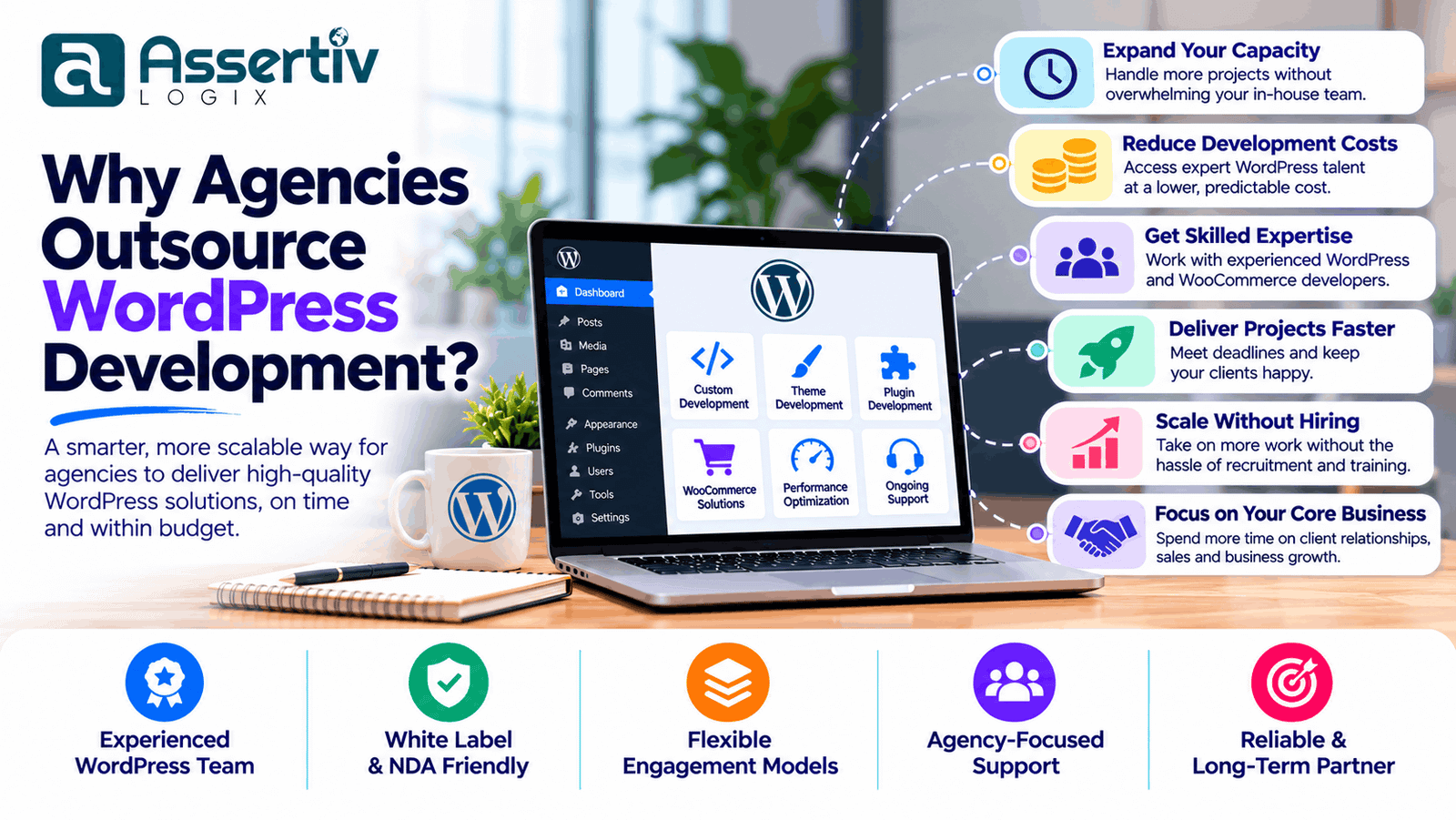
Running a digital agency involves much more than building websites. Agencies must manage client relationships, prepare proposals, coordinate projects, meet deadlines, maintain quality standards, and continuously find new business opportunities. As the number of client projects increases, handling every technical task with an in-house team can become challenging.
This is one of the main reasons agencies outsource WordPress development. Instead of recruiting developers for every technical requirement, an agency can work with an external development partner to handle specific projects, ongoing development tasks, or specialist WordPress requirements.
Outsourcing can give agencies access to experienced developers, additional delivery capacity, and more flexible resource planning. It can also help them offer services such as custom theme development, plugin development, WooCommerce customization, and API integrations without maintaining every skill internally.
However, outsourcing is not simply about reducing development costs. It is a business decision that can affect project quality, delivery timelines, client satisfaction, and long-term profitability.
In this guide, we explain why agencies outsource WordPress development, the main benefits, potential challenges, and how to choose the right development partner.
What Does It Mean to Outsource WordPress Development?
WordPress development outsourcing means hiring an external developer, development team, or specialist company to complete WordPress-related work on behalf of your agency.
The agency remains responsible for its client relationship and commercial agreement, while the external team handles the technical tasks defined in the project scope.
For example, a digital marketing agency may win a project to redesign a client’s WordPress website. The agency manages the client, prepares the design direction, and coordinates the project, while an external development partner implements the website.
Depending on the agreement, the outsourcing partner may work directly with the agency or operate under a white-label arrangement where the agency delivers the completed work using its own brand.
Common outsourced WordPress services include:
- Custom WordPress website development
- WordPress theme design and development
- Custom plugin development
- WooCommerce store development
- Payment gateway integrations
- Third-party API integrations
- Website migration and redesign
- WordPress speed optimization
- Website security improvements
- Ongoing maintenance and technical support
The agency can outsource an entire project or only the tasks that require additional technical capacity.
Why Do Agencies Outsource WordPress Development?
Agencies outsource WordPress development for different business reasons. Some want to manage increasing project demand, while others need specialist technical skills or a more flexible way to deliver client work.
Here are ten important reasons.
1. Reduce the Cost of Maintaining an In-House Development Team
Hiring developers involves more than paying salaries. Agencies also need to consider recruitment, onboarding, employee benefits, software, hardware, training, management, and the time required to maintain a productive team.
These expenses can become difficult to justify when project demand changes from month to month.
Outsourcing provides another way to access development resources. Instead of maintaining full-time capacity for every technical requirement, an agency can engage external developers when suitable work becomes available.
This can help businesses manage resource costs more flexibly.
However, outsourcing is not automatically cheaper. Agencies should compare the total cost of an external provider with the full cost of in-house delivery, including project management, quality assurance, revisions, and support.
2. Access Experienced WordPress Developers
WordPress projects can involve different technical requirements. A standard business website may need theme customization, while a complex WooCommerce project could require custom checkout functionality, payment integrations, or advanced product logic.
An agency may not have every specialist skill available internally.
Outsourcing allows agencies to work with developers who have experience in areas such as:
- WordPress core and custom development
- PHP and MySQL
- Custom theme architecture
- WordPress plugin development
- WooCommerce customization
- REST API integrations
- JavaScript and frontend development
- Website performance optimization
This can help agencies take on projects that require expertise beyond their existing team’s capabilities.
3. Handle More Client Projects
An agency may have a strong sales pipeline but limited development capacity. When several clients request new websites or technical improvements at the same time, the internal team can become overloaded.
Outsourcing can provide additional capacity when the agency needs it.
For example, an agency with an internal design team may outsource WordPress implementation while continuing to manage design, content, and client communication.
This arrangement can help the agency accept suitable additional projects without immediately expanding its permanent workforce.
The important point is to confirm the external partner’s availability before committing to client deadlines.
4. Focus More on Business Growth and Client Relationships
Agency owners and managers often spend significant time coordinating technical tasks. This can reduce the time available for sales, marketing, partnerships, strategy, and customer relationships.
With a reliable development partner, agencies can delegate agreed technical work and concentrate more on business development.
Their internal teams can focus on:
- Finding new clients
- Preparing proposals
- Understanding business requirements
- Managing client accounts
- Planning website experiences
- Developing marketing strategies
- Building long-term relationships
Outsourcing does not remove the need for project management. Instead, it can allow the agency to distribute responsibilities more effectively.
5. Scale Services Without Hiring for Every Requirement
Client demand is rarely consistent. An agency may receive several website projects in one month and fewer development requests in the next.
Hiring full-time developers for every increase in workload can create unnecessary fixed costs.
Outsourcing provides flexibility to engage external resources based on project requirements and availability.
For example, an agency can:
- Outsource custom plugin development for a specific project.
- Bring in WooCommerce specialists for eCommerce work.
- Use external developers during busy periods.
- Arrange ongoing support for recurring client requirements.
- Increase or reduce external capacity as project demand changes.
This can make it easier to grow the agency’s service offering without making every resource commitment permanent.
6. Offer More WordPress and WooCommerce Services
An agency may primarily focus on website design, SEO, branding, or digital marketing. However, clients often request additional technical services after the initial project.
These may include custom WordPress functionality, WooCommerce development, integrations, migrations, and performance improvements.
An outsourcing partner can help the agency extend its service offering.
For example, an agency could offer:
Custom WordPress development: Custom themes, templates, plugins, and business functionality.
WooCommerce development: Online store setup, custom product features, checkout improvements, and payment integrations.
API integrations: Connecting WordPress websites with CRMs, marketing platforms, payment services, and other business systems.
Website optimization: Improving loading performance, technical stability, and website usability.
Maintenance and support: Managing updates, backups, bug fixes, and agreed technical maintenance tasks.
This gives agencies more opportunities to support existing clients and attract new business.
7. Improve Project Delivery Capacity
When an internal team is overloaded, deadlines can become difficult to manage. Development tasks may compete for the same resources, and projects can experience delays.
An external development team can provide additional implementation capacity when workloads increase.
A structured outsourcing workflow should include:
- Clear project requirements
- Defined deliverables
- Development milestones
- Regular progress updates
- Staging environment access
- Quality assurance
- Client feedback and revision handling
- Final handover documentation
Outsourcing alone does not guarantee faster delivery. The improvement depends on the partner’s availability, technical capability, communication, and project planning.
8. Access Specialist Skills for Complex Projects
Some WordPress projects require expertise that an agency may not need every month.
Examples include:
- Custom WooCommerce checkout development
- Complex payment gateway integrations
- WordPress multisite implementation
- Custom membership platforms
- Advanced API integrations
- Performance troubleshooting
- Custom plugin architecture
- Migration of large WordPress websites
Hiring a permanent specialist for occasional projects may not be practical.
An outsourcing partner with relevant experience can provide access to those skills when needed. Agencies should still review previous work, technical approach, security practices, and testing procedures before assigning complex tasks.
9. Support White-Label Service Delivery
Many agencies want to offer website development under their own brand without exposing the external technical provider to the end client.
A white-label outsourcing arrangement makes this possible when both parties agree to the branding and communication terms.
The agency manages the customer relationship, while the development partner handles the agreed implementation work behind the scenes.
This can be useful for:
- Digital marketing agencies
- Branding and design studios
- SEO companies
- Freelance consultants
- Web design agencies
- IT service providers
A successful white-label relationship requires clear confidentiality terms, ownership agreements, communication rules, and quality standards.
For a more detailed explanation, read our guide to White Label WordPress Development Services.
10. Maintain Flexibility as the Agency Grows
An agency’s technical requirements may change as its services, customer base, and project types evolve.
Outsourcing can help the business adapt without making every change through permanent hiring.
An agency might begin by outsourcing basic WordPress development, then use specialist support for WooCommerce, custom plugin development, or integrations as its service offering expands.
The agency can evaluate its actual workload over time and decide which capabilities should remain internal and which are better supported externally.
A balanced approach can combine internal employees, freelancers, and external development partners.
Outsourcing WordPress Development vs. Hiring In-House
Both approaches can work well. The right choice depends on project volume, the need for direct control, specialist requirements, and the agency’s long-term business plans.
| Factor | Outsourcing | In-house team |
|---|---|---|
| Resource model | External project or service engagement | Permanent or directly employed resources |
| Cost structure | Often variable by scope or capacity | Includes ongoing employment and operating costs |
| Specialist access | Can access external expertise | Depends on skills recruited internally |
| Workload flexibility | Can adjust based on partner availability | Requires internal resource planning |
| Direct control | Managed through scope and agreements | Greater day-to-day organizational control |
| Team integration | Requires clear communication and processes | Usually easier for daily collaboration |
| Long-term continuity | Depends on the partner agreement | Can provide consistent internal knowledge |
| Best suited for | Variable demand and specialist tasks | Consistent workloads and core capabilities |
When Should an Agency Outsource?
Outsourcing may be suitable when:
- The agency has more projects than its internal team can handle.
- A client needs technical skills the agency does not have.
- Hiring a full-time developer is not commercially justified.
- The agency wants to introduce new WordPress services.
- Project demand changes throughout the year.
- A white-label partner can support the agency’s delivery workflow.
When Should an Agency Hire In-House?
An internal team may be a better option when:
- Development work is consistently available.
- The business requires close daily collaboration.
- The technical product is central to the agency’s operations.
- Long-term product knowledge and internal ownership are essential.
- The agency needs direct control over daily development priorities.
Many agencies use a hybrid model, keeping core capabilities in-house and outsourcing specialist or overflow work.
What WordPress Development Tasks Should Agencies Outsource?
Not every task needs to be outsourced. Agencies should identify where external support creates the most value.
| Development task | Outsourcing suitability |
|---|---|
| Custom WordPress themes | Suitable for project-based work |
| Custom plugin development | Useful for specialist requirements |
| WooCommerce development | Suitable for complex or additional workloads |
| Website migration | Suitable for defined migration projects |
| API integrations | Useful when specialist experience is required |
| Speed optimization | Suitable for technical audits and improvements |
| Website maintenance | Suitable for recurring support agreements |
| Bug fixing | Useful for overflow or specialist troubleshooting |
| Full website development | Suitable when scope and responsibilities are clear |
The decision should consider project complexity, access requirements, confidentiality, internal expertise, and the cost of managing an external provider.
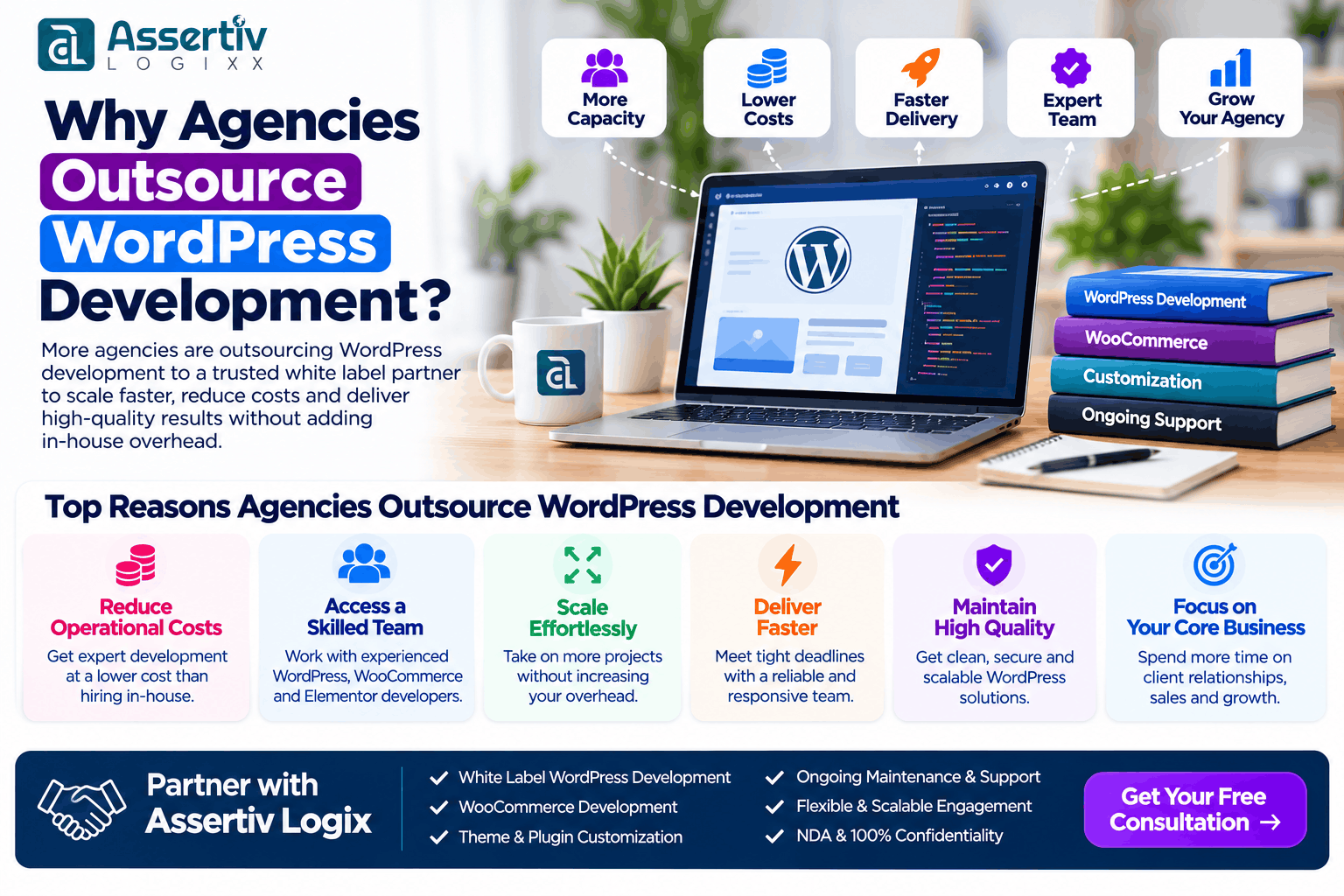
Potential Challenges of Outsourcing WordPress Development
Outsourcing can provide business advantages, but it also introduces responsibilities that agencies must manage.
Communication Gaps
Incomplete requirements or unclear communication can lead to misunderstandings and additional revisions.
How to manage it: Use written project briefs, agreed communication channels, regular progress updates, and clear acceptance criteria.
Quality Control
The agency remains responsible for the experience it delivers to its client, even when development is completed externally.
How to manage it: Establish coding standards, review deliverables, test important functionality, and use a documented quality assurance checklist.
Delivery Delays
An external team may have other projects, resource limitations, or dependencies that affect delivery.
How to manage it: Confirm availability before starting, agree on milestones, identify dependencies, and communicate risks early.
Data Security and Access
WordPress projects may involve customer information, production systems, hosting accounts, and administrative credentials.
How to manage it: Use confidentiality agreements, least-privilege access, secure credential sharing, staging environments, and appropriate access revocation after project completion.
Unclear Project Ownership
Disagreements can occur when contracts do not explain who owns custom code, designs, documentation, and other deliverables.
How to manage it: Define intellectual property ownership, licensing, source-code handover, and payment-related ownership terms in writing.
Dependency on One Provider
Relying entirely on one external development partner can create business continuity risks.
How to manage it: Maintain project documentation, control access to important accounts, retain source-code access, and establish a practical backup plan.
How to Choose the Right WordPress Development Outsourcing Partner
Selecting a development partner is an important business decision. The provider should be technically capable, dependable, and able to work within your agency’s delivery process.
1. Review WordPress Experience
Check whether the provider has experience with the services you plan to outsource.
Relevant experience may include WordPress theme development, custom plugins, WooCommerce, API integrations, migrations, and performance optimization.
2. Evaluate Previous Projects
Review portfolio examples and ask what the provider was responsible for delivering.
Look beyond visual design. Where relevant, assess functionality, responsiveness, maintainability, and the complexity of the implementation.
3. Understand the Development Process
Ask how projects move from requirements to development, testing, approval, and handover.
A structured process reduces uncertainty and makes it easier for the agency to manage multiple client projects.
4. Check Communication and Availability
Confirm the primary point of contact, working hours, progress reporting, escalation process, and expected response times.
If the agency serves international clients, consider time-zone overlap and how urgent requests will be handled.
5. Discuss Pricing and Commercial Terms
Clarify whether the provider charges per project, by the hour, through a monthly retainer, or through a dedicated resource arrangement.
Also confirm revision limits, additional work rates, payment milestones, and post-launch support.
For more information, read our WordPress Development Outsourcing Guide.
6. Confirm Confidentiality and Ownership
A written agreement should cover client confidentiality, intellectual property, source-code ownership, licenses, subcontracting, access permissions, and any restrictions on direct client contact.
Do not rely on informal assurances for sensitive commercial terms.
7. Start With a Small Project
A small paid project can help evaluate technical quality, communication, delivery reliability, and responsiveness to feedback before assigning larger client projects.
How Assertivlogix Supports Agencies With WordPress Development
Assertivlogix provides WordPress and WooCommerce development services for businesses and agencies that need additional technical expertise and development capacity.
We understand that agencies need more than code delivery. They need a development partner that can work with project requirements, design specifications, delivery milestones, quality expectations, and ongoing support needs.
Depending on the project, our development services include:
- Custom WordPress website development
- WordPress theme development and customization
- Custom WordPress plugin development
- WooCommerce store development
- Custom WooCommerce functionality
- Third-party API integrations
- WordPress migration and redesign
- Website speed and performance optimization
- Website maintenance and technical support
Agencies can discuss project-based development requirements and potential white-label working arrangements with our team.
Explore our WordPress development services or learn more about our WooCommerce development services.
Expand your agency’s delivery capacity with custom WordPress and WooCommerce development support from Assertivlogix. Share your requirements and discuss a suitable working arrangement with our team.
Frequently Asked Questions
Why do digital agencies outsource WordPress development?
Digital agencies outsource WordPress development to access specialist skills, manage changing workloads, reduce the need for permanent hiring, expand their service offerings, and handle additional client projects.
Is outsourcing WordPress development cost-effective?
It can be cost-effective when the agency’s workload varies or when specialist skills are needed occasionally. However, agencies should compare provider fees with the full cost of internal delivery, including management, testing, revisions, and support.
What WordPress services can agencies outsource?
Agencies can outsource custom website development, theme development, plugin development, WooCommerce customization, API integrations, website migrations, performance optimization, and maintenance.
Is outsourcing better than hiring an in-house WordPress developer?
Neither approach is always better. Outsourcing can provide flexibility and specialist access, while in-house hiring offers closer daily collaboration and continuity. A hybrid model can combine the advantages of both.
Can agencies outsource WordPress development under their own brand?
Yes. Agencies can use a white-label arrangement where the external provider completes agreed technical work while the agency manages the client relationship and presents the deliverables under its own brand. The terms should be documented in a written agreement.
How do agencies find reliable WordPress development partners?
Agencies should review relevant experience, portfolio work, technical skills, communication, project management, pricing, quality assurance, security practices, and contractual terms. Starting with a small project is a practical way to evaluate a provider.
When should a WordPress agency consider outsourcing?
An agency should consider outsourcing when its internal team lacks capacity, a project requires specialist technical skills, hiring is not commercially justified, or the business wants to offer additional development services.
Conclusion
Agencies outsource WordPress development to manage technical workloads, access experienced developers, expand service offerings, and create more flexible delivery operations.
The right outsourcing arrangement can help an agency take on suitable projects without building every technical capability internally. However, success depends on choosing a reliable partner, defining project responsibilities, protecting client information, maintaining quality standards, and planning for ongoing support.
Whether you need help with a single WordPress project or recurring development requirements, a well-managed outsourcing partnership can become a valuable extension of your agency’s team.