
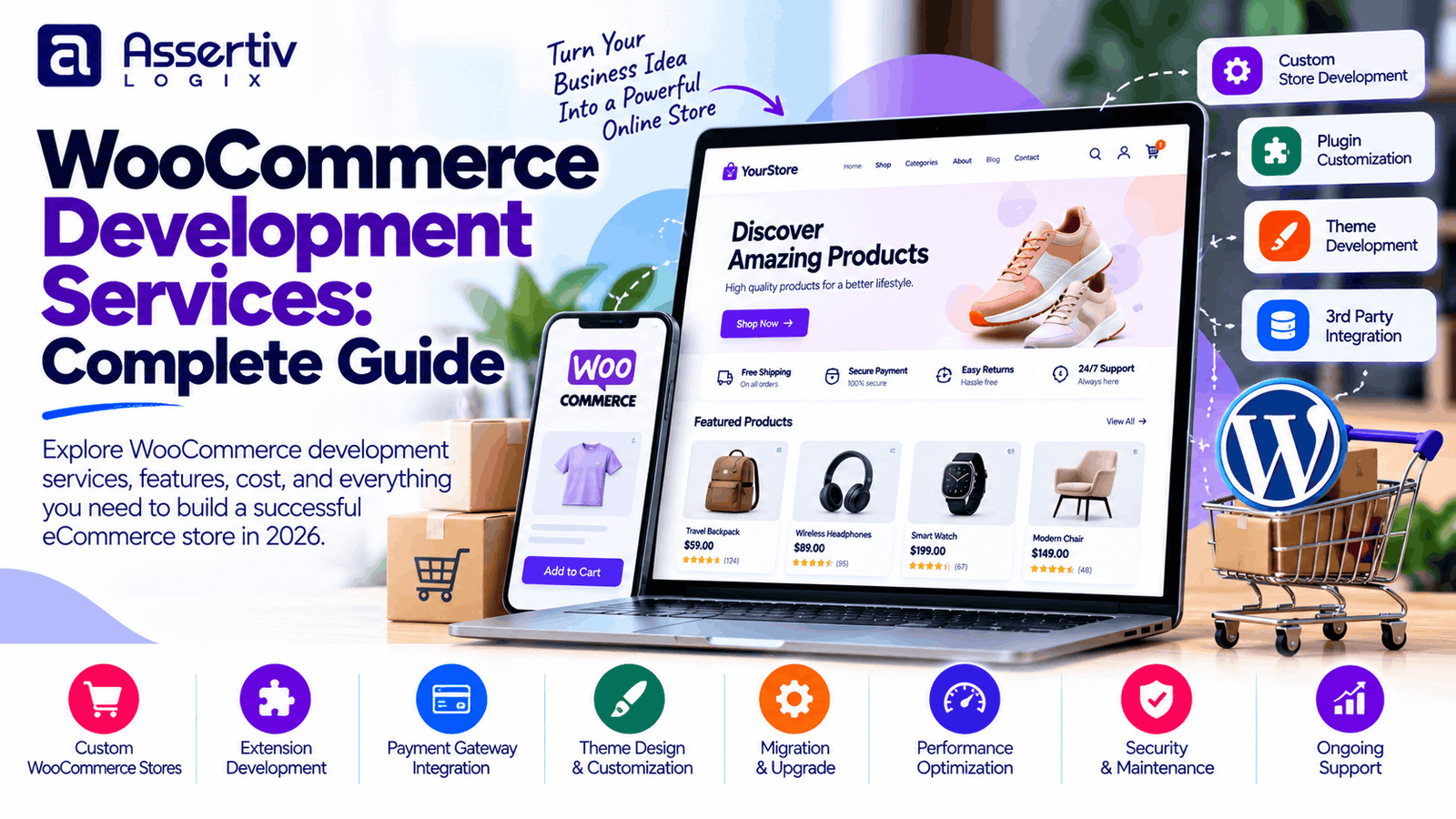
WooCommerce development services help businesses build, customize, and improve online stores using WordPress and WooCommerce. Whether you’re launching your first ecommerce website or upgrading an existing store, the right development approach can make it easier to manage products, accept payments, process orders, and grow your business.
Not every store needs a complicated custom build. Some businesses can get started with a well-configured WooCommerce theme, while others need custom product pages, subscription billing, advanced shipping rules, ERP integrations, or a multi-vendor marketplace.
The key is to choose a solution that fits the way your business operates instead of paying for features you may never use.
At Assertivlogix, WooCommerce projects can cover store setup, custom design, plugin development, integrations, migration, performance improvements, and ongoing technical support. This guide explains the main services, when they are useful, and what to consider before starting a project.
What Are WooCommerce Development Services?
WooCommerce development services cover the technical and design work required to build and maintain an online store with WooCommerce.
That can mean setting up a new store, improving an existing website, building custom functionality, or connecting the store with other business systems.
For example, a small retailer might need product setup, payment configuration, and a mobile-friendly theme. A growing ecommerce company might need inventory synchronization, automated order processing, custom checkout fields, or connections to accounting software.
WooCommerce is built on WordPress, so the platform can be extended through themes, plugins, APIs, and custom PHP development. The best approach depends on your requirements, budget, and plans for growth.
You can learn more about the platform in the official WooCommerce documentation.
WooCommerce Development Services for Growing Businesses
1. WooCommerce Store Development
A new ecommerce store needs more than a homepage and a product grid. Customers should be able to find products, understand pricing, choose variations, add items to their cart, and complete checkout without unnecessary friction.
Store development can include:
- WordPress and WooCommerce installation
- Theme configuration and responsive layouts
- Product and category setup
- Cart and checkout configuration
- Payment gateway integration
- Shipping and tax settings
- Transactional email setup
- Testing before launch
The scope depends on the number of products, design requirements, shipping rules, and whether the business needs custom functionality.
2. Custom WooCommerce Design
Your store should reflect your brand without making shopping harder for customers.
Custom design services can improve the homepage, product pages, category layouts, navigation, search, cart, and checkout. They can also address mobile usability, where shoppers may have less screen space and less patience for complicated forms.
A custom theme or tailored theme development may be appropriate when off-the-shelf designs cannot support the desired experience. For simpler projects, carefully customizing an existing theme may be more cost-effective.
3. Custom WooCommerce Plugin Development
Sometimes a store needs functionality that isn’t available in an existing plugin, or an available extension doesn’t match the business workflow.
Custom WooCommerce development can address requirements such as:
- Special product pricing rules
- Custom product configuration
- Additional checkout fields
- Customer-specific discounts
- Order automation
- Custom shipping logic
- Connections with internal business systems
Custom code should be designed with future updates in mind. Using WooCommerce hooks, filters, APIs, and documented extension points can reduce the need to modify core platform files.
For broader WordPress functionality, explore our WordPress Plugin Development Services.
4. WooCommerce Payment Gateway Integration
Payment options affect both customer convenience and the checkout experience. Depending on the target market, a store may need card payments, digital wallets, local payment methods, or bank-based payment options.
Integration work may include gateway configuration, checkout testing, payment status handling, refunds, and troubleshooting failed transactions.
For recurring payments or marketplace payouts, additional planning is required because not every gateway supports the same subscription or payout workflows.
Payment provider availability, fees, and eligibility vary by country and business type, so these should be checked before development begins.
5. Shipping, Tax, and Inventory Integration
Shipping becomes more complicated as a business adds products, locations, delivery options, and sales channels.
A store might need flat-rate shipping, weight-based rates, courier integrations, local pickup, or different shipping rules for particular products. Tax settings also need to reflect the business’s obligations and operating regions.
Inventory integration is especially useful when products are sold through more than one channel. Synchronizing stock can reduce manual work and help prevent orders for unavailable items.
6. WooCommerce API and Third-Party Integrations
An ecommerce website often needs to exchange data with other systems. Depending on the business, integrations may connect WooCommerce with a CRM, ERP, accounting platform, warehouse system, marketing tool, or external application.
Integration requirements should be documented before development. Important questions include which system owns each data field, how frequently information should synchronize, and what should happen if an API request fails.
The WooCommerce documentation is a useful starting point for understanding the platform’s capabilities and available integrations.
7. WooCommerce Speed Optimization
A slow store can make browsing and checkout frustrating. Performance problems may come from oversized images, unnecessary plugins, inefficient database queries, third-party scripts, or hosting that no longer matches the store’s needs.
Performance optimization can include:
- Image compression and appropriate image sizing
- Page and object caching where suitable
- Database and query optimization
- Reviewing plugin and theme overhead
- Reducing unnecessary scripts
- Improving server and hosting configuration
- Testing key shopping and checkout pages
Changes should be tested carefully because aggressive caching or script optimization can interfere with cart and checkout functionality.
For a deeper pricing discussion, see our WordPress Speed Optimization Cost and ROI guide.
8. WooCommerce Security and Maintenance
An online store handles customer accounts, order information, and payment-related workflows. Keeping the website maintained is therefore an ongoing responsibility, not something to consider only at launch.
Security and maintenance work may include software updates, backups, access reviews, malware checks, compatibility testing, uptime monitoring, and recovery planning.
Payment information should be handled through suitable payment providers and compliant integration methods. Businesses should avoid storing sensitive payment data themselves unless they have the necessary expertise and compliance arrangements.
Our WordPress Maintenance Cost guide explains common ongoing support expenses.
9. WooCommerce Migration and Redesign
Moving an existing store to WooCommerce or rebuilding an outdated store requires careful planning.
A migration may involve product data, customer accounts, orders, images, categories, URLs, redirects, payment configuration, and shipping rules. The exact requirements depend on the source platform.
Before moving the store, create a backup, map the data, test the import, and check important URLs. After launch, verify checkout, order processing, customer access, and search visibility.
A redesign should also preserve useful functionality rather than changing the appearance while overlooking the workflows customers rely on.
When Does Your Business Need Custom WooCommerce Development?
Custom development is worth considering when an existing theme or plugin cannot meet an important business requirement reliably.
Common examples include wholesale pricing, customer-specific catalogs, product builders, subscriptions, complex discounts, multi-vendor functionality, and integration with internal software.
Before building a custom feature, check whether an established extension already solves the problem. A suitable plugin may reduce initial development time, while custom development can provide more control when the requirement is specific to your business.
The decision should consider not only the initial price but also compatibility, maintenance, licensing, and future changes.
What to Prepare Before Starting a WooCommerce Project
Clear requirements help developers estimate the work more accurately and reduce avoidable changes later.
Before requesting a quote, prepare the following information:
- Product count and product types
- Target countries and currencies
- Required payment gateways
- Shipping providers and delivery rules
- Design references and brand assets
- Required plugins or business integrations
- Any subscription, wholesale, or marketplace functionality
- Expected launch date
- Ongoing support expectations
You don’t need to know every technical detail. A clear description of how the business works and what customers should be able to do is a good starting point.
How Much Do WooCommerce Development Services Cost?
The price depends on the scope, customization, and complexity of the store. The following figures are broad planning estimates rather than fixed Assertivlogix quotations.
| Project Type | Indicative Development Budget |
|---|---|
| Basic WooCommerce store | $1,000–$2,000+ |
| Professional business store | $2,000–$4,000+ |
| Custom WooCommerce store | $4,000–$8,000+ |
| Advanced integrations or workflows | $8,000–$15,000+ |
| Complex ecommerce platform | $15,000+ |
Hosting, premium plugin licenses, payment processing, product data preparation, and ongoing maintenance may be separate expenses. A detailed proposal should state what is included and what will be billed separately.
For more context, read our eCommerce WordPress Website Cost guide.
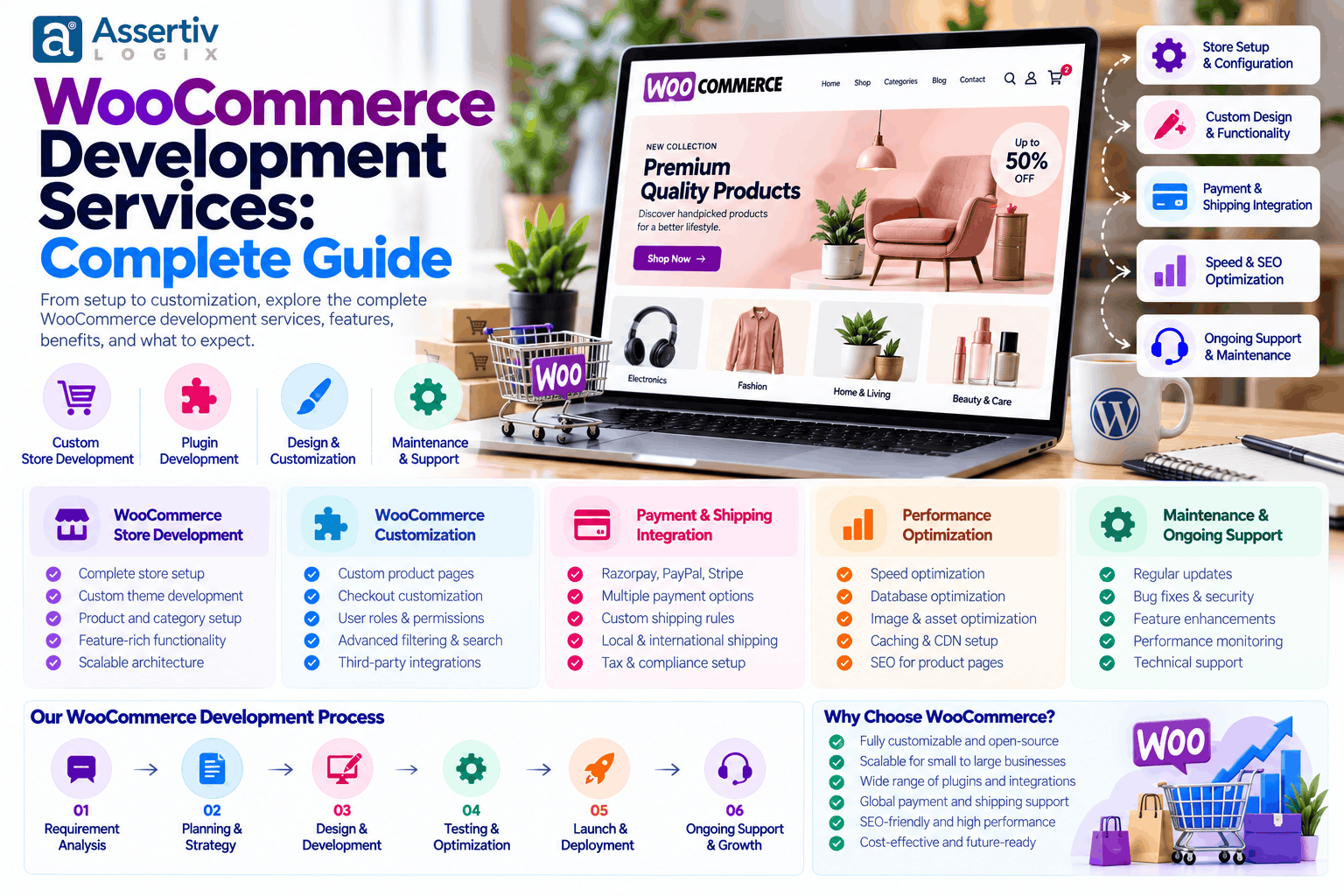
Our WooCommerce Development Process
Step 1: Understand the Business
We start by identifying the products, customers, order workflow, and business goals. This helps determine which features are essential for launch.
Step 2: Define the Scope
The project scope identifies design requirements, store functionality, integrations, deliverables, and any assumptions that affect the estimate.
Step 3: Design and Development
The store is built around the agreed requirements. This may involve theme customization, product setup, payment configuration, custom code, and third-party integrations.
Step 4: Testing
Before launch, important workflows should be tested on desktop and mobile. That includes product selection, cart updates, checkout, payment status, order emails, and administrative tasks.
Step 5: Launch and Support
After launch, the team checks the live store and resolves issues within the agreed scope. Ongoing maintenance can be arranged according to the store’s needs.
How to Choose a WooCommerce Development Company
The right development partner should understand both WordPress and the practical details of running an ecommerce business.
When comparing providers, ask to see relevant work, clarify who will handle integrations, and confirm how the project will be tested.
It’s also worth asking:
- Will the store be responsive on mobile devices?
- Are payment and shipping integrations included?
- Will custom functionality be documented?
- Who manages premium plugin licenses?
- Is migration or product data entry included?
- What happens if a problem appears after launch?
A lower initial quotation may not include the same deliverables as a more comprehensive proposal. Compare scope, assumptions, testing, and support—not just the total price.
WooCommerce Development Services from Assertivlogix
Assertivlogix helps businesses plan and develop WordPress and WooCommerce solutions around their products and operational requirements.
Depending on the project, our services can cover store development, custom design, plugin development, API integrations, migration, performance improvements, and ongoing maintenance.
Whether you’re launching a new store or improving an existing one, the first step is to define what the store needs to do and which features will make a real difference to your customers.
Share your products, design goals, payment and shipping requirements, and any custom functionality you need. We’ll help you identify the appropriate development scope and discuss the next steps.
Final Thoughts
WooCommerce development services cover much more than installing an ecommerce plugin. A successful store needs a sensible structure, a smooth shopping experience, reliable payments, appropriate security, and a maintenance plan that fits the business.
Start with the features customers need today. Choose established tools where they fit, invest in custom development where it solves a real problem, and make sure the website can be maintained as the business grows.
A well-scoped project gives you a clearer budget, fewer surprises during development, and a store that’s easier to manage after launch.
Frequently Asked Questions
What are WooCommerce development services?
They include WooCommerce store setup, custom design, theme and plugin development, payment and shipping integrations, migration, performance optimization, security, and ongoing support.
How much do WooCommerce development services cost?
A basic store may cost around $1,000–$2,000+, a professional store around $2,000–$4,000+, and more customized ecommerce projects $4,000–$15,000 or more. Actual costs depend on requirements and scope.
Can WooCommerce be customized for my business?
Yes. WooCommerce supports themes, plugins, hooks, filters, and APIs. Custom development can add business-specific pricing, checkout workflows, integrations, and other functionality.
Can you integrate payment gateways and shipping services?
WooCommerce supports many payment and shipping integrations. The available options depend on the provider, country, business model, and technical requirements.
Can an existing online store be migrated to WooCommerce?
Yes. Migration can include products, categories, customer records, orders, images, and URL redirects, depending on the source platform and data structure. The migration should be tested before launch.
Does a WooCommerce store need ongoing maintenance?
Yes. Updates, backups, security checks, compatibility testing, and troubleshooting help keep the store reliable. The amount of support needed depends on the complexity and business importance of the website.
How do I get a WooCommerce development quote?
Share your store requirements, product count, design preferences, payment and shipping needs, and any required integrations. You can contact Assertivlogix to discuss your project.