
If you’re deciding between WooCommerce vs Shopify 2026, you’re not alone. Thousands of business owners compare these two ecommerce platforms every year to determine which offers the best value, flexibility, performance, and long-term growth. In this guide, we’ll compare WooCommerce and Shopify across pricing, SEO, customization, security, scalability, and overall cost to help you make the right decision for your business.
Shopify is known for its ease of use and fully hosted environment, while WooCommerce offers unmatched flexibility, ownership, and customization through WordPress. The right choice depends on your budget, technical requirements, growth plans, and long-term business goals.
In this guide, we’ll compare WooCommerce and Shopify across pricing, performance, customization, SEO, scalability, security, and overall value to help you make an informed decision.
WooCommerce vs Shopify: Quick Overview
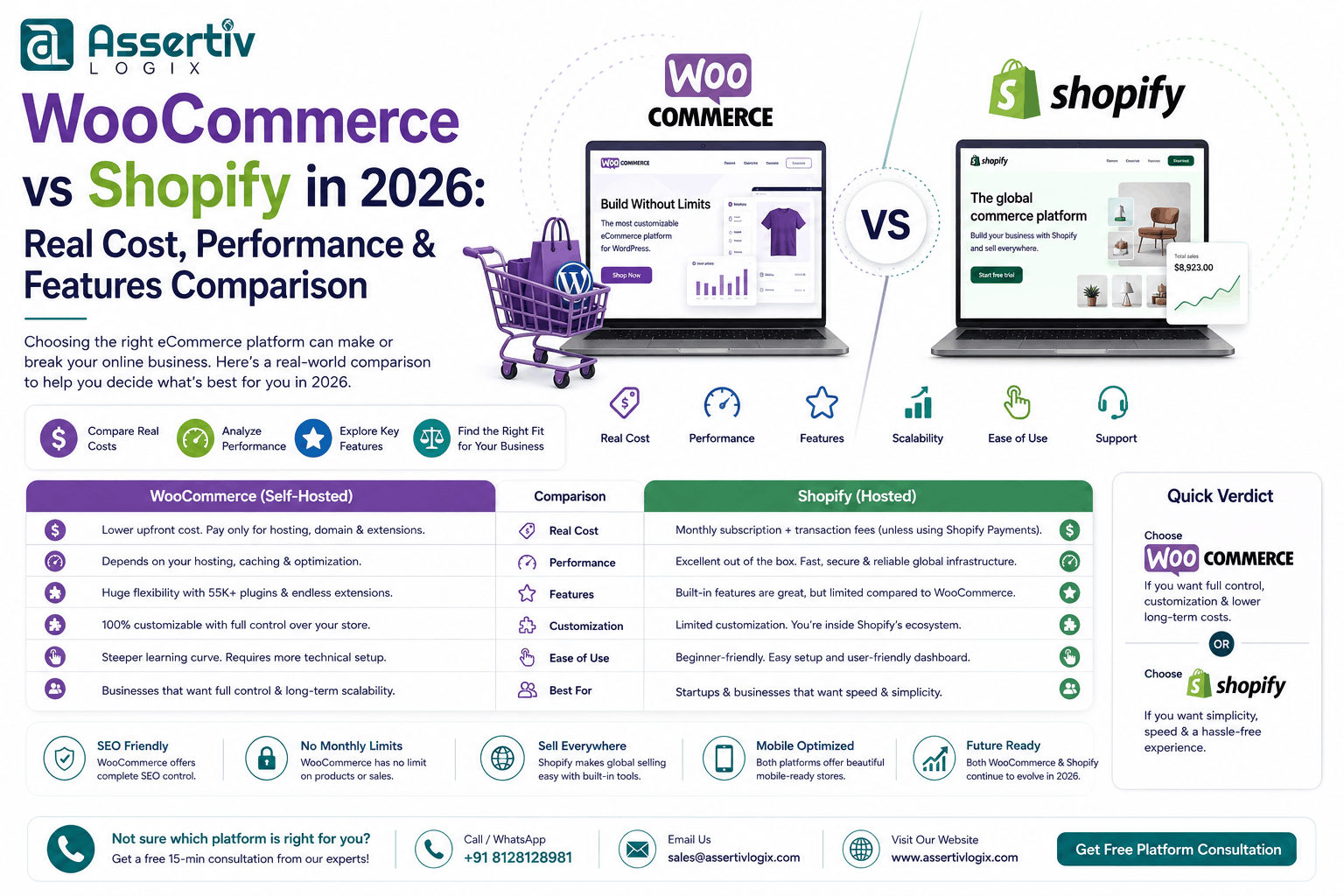
| Feature | WooCommerce | Shopify |
|---|---|---|
| Platform Type | Open-source WordPress plugin | Hosted SaaS platform |
| Ownership | Full ownership of website and data | Hosted by Shopify |
| Customization | Unlimited | Moderate |
| Hosting | Choose your own hosting | Included |
| SEO Flexibility | Excellent | Good |
| Scalability | Excellent | Excellent |
| Monthly Platform Fee | No platform fee | Monthly subscription required |
Pricing Comparison
WooCommerce Costs
WooCommerce itself is free, but you’ll need to budget for hosting, a domain, premium plugins (if required), and optional premium themes.
Typical annual expenses include:
- Hosting
- Domain registration
- SSL certificate (often included with hosting)
- Premium extensions (optional)
- Maintenance and support
You only pay for the features you actually use, making WooCommerce highly cost-effective for businesses that want flexibility.
Shopify Costs
Shopify operates on a subscription model with monthly platform fees. Additional costs may include premium themes, paid apps, payment processing fees (depending on your payment provider), and custom development.
As your store grows and you add more functionality, monthly operating costs can increase.
Customization & Flexibility
WooCommerce is built on WordPress, giving you complete control over your website’s design, functionality, and data. Developers can create custom themes, plugins, integrations, and workflows tailored to your business.
Shopify offers a polished ecosystem with themes and apps, but customization is generally limited to what the platform allows. Advanced changes may require working within Shopify’s framework and template language.
Performance
Performance depends on how your store is built and maintained.
WooCommerce performance is largely influenced by your hosting provider, theme, plugins, caching strategy, and optimization efforts. With quality hosting and proper optimization, WooCommerce can achieve excellent Core Web Vitals and handle significant traffic.
Shopify manages the hosting environment for you, providing reliable performance out of the box. However, you have less control over server-level optimization.
For WooCommerce stores, our WooCommerce Performance Guide provides actionable optimization tips.
SEO Capabilities
Search engine optimization is essential for attracting organic traffic.
WooCommerce SEO
- Complete control over URLs.
- Advanced metadata customization.
- Powerful SEO plugins.
- Schema markup support.
- Flexible content marketing with WordPress.
- Easy blog integration.
Shopify SEO
- Built-in SEO features.
- Automatic XML sitemaps.
- Structured data support.
- Simplified optimization.
While Shopify offers strong SEO features, WooCommerce generally provides greater flexibility for businesses with advanced SEO requirements.
Content Marketing
Content marketing plays a major role in ecommerce success.
WooCommerce benefits from WordPress, the world’s leading content management system. Creating blogs, landing pages, buying guides, tutorials, and resource centers is straightforward and highly customizable.
If content marketing is a significant part of your growth strategy, WooCommerce has a clear advantage.
Scalability
Both platforms can support growing businesses, but they approach scalability differently.
WooCommerce allows you to scale your hosting infrastructure, optimize databases, and build custom integrations as your business expands.
Shopify handles server scaling automatically, making it an attractive option for merchants who prefer a managed environment.
App & Plugin Ecosystem
WooCommerce benefits from the extensive WordPress ecosystem, offering thousands of plugins for marketing, payments, shipping, memberships, automation, analytics, and more.
Shopify provides an extensive app marketplace, although many apps require recurring subscription fees.
Payment Gateways
WooCommerce supports a wide range of payment gateways, giving merchants flexibility to choose providers that meet their business needs.
Shopify also supports numerous payment options, with its own integrated payment solution available in many regions.
Security
Shopify manages security updates, hosting infrastructure, and PCI compliance for the platform.
With WooCommerce, security responsibilities are shared between the site owner, hosting provider, and developers. Following best practices—including regular updates, secure hosting, backups, and monitoring—can help maintain a secure store.
Read our WordPress Security Checklist for practical security recommendations.
WooCommerce vs Shopify: Pros & Cons
| WooCommerce | Shopify |
|---|---|
| Full ownership of your website and data | Easy setup and maintenance |
| Unlimited customization | Managed hosting included |
| Powerful SEO capabilities | User-friendly interface |
| Large WordPress ecosystem | Reliable infrastructure |
| Flexible hosting choices | Less technical management required |
Who Should Choose WooCommerce?
- Businesses seeking full ownership and control.
- Companies investing heavily in SEO and content marketing.
- Stores requiring custom functionality or integrations.
- Organizations planning long-term growth with scalable infrastructure.
- Businesses already using WordPress.
Who Should Choose Shopify?
- Businesses wanting an all-in-one hosted platform.
- Merchants looking for a quick setup with minimal technical management.
- Small teams that prefer a simplified ecommerce solution.
Frequently Asked Questions
Which platform is better for SEO?
Both platforms support SEO, but WooCommerce generally offers more flexibility thanks to WordPress and its extensive ecosystem of SEO tools.
Which platform is more cost-effective?
WooCommerce can be more cost-effective over time because you choose your hosting and extensions. Shopify provides predictable monthly pricing but may incur additional costs as you add premium apps and features.
Can I migrate from Shopify to WooCommerce later?
Yes. Many businesses migrate from Shopify to WooCommerce to gain greater flexibility, ownership, and customization as their requirements evolve.
If you’re planning a migration, follow our WordPress Migration Checklist.
Not Sure Which Platform Is Right for You?
Every business has unique goals, budgets, and technical requirements. Choosing the right ecommerce platform today can save significant time and money as your business grows.
Assertivlogix offers a FREE 15-minute platform consultation to help you evaluate whether WooCommerce or Shopify is the better fit for your business.
During the consultation, we’ll discuss:
- Your business model and growth plans.
- Expected traffic and product catalog size.
- SEO and marketing requirements.
- Customization and integration needs.
- Estimated setup and maintenance costs.
Book your free consultation today:
https://www.assertivlogix.com/contact-us/
Conclusion
WooCommerce and Shopify are both excellent ecommerce platforms, but they cater to different business needs. Shopify provides a streamlined, hosted experience that’s easy to manage, while WooCommerce delivers unmatched flexibility, ownership, and customization for businesses that want complete control over their online store.
If your priority is long-term scalability, advanced SEO, custom functionality, and content-driven growth, WooCommerce is often the stronger choice. If you prefer a managed solution with minimal technical overhead, Shopify may be the better fit.
At Assertivlogix, we help businesses build, optimize, migrate, and scale ecommerce stores with expert WooCommerce Development, WordPress Development, performance optimization, and ongoing support.