
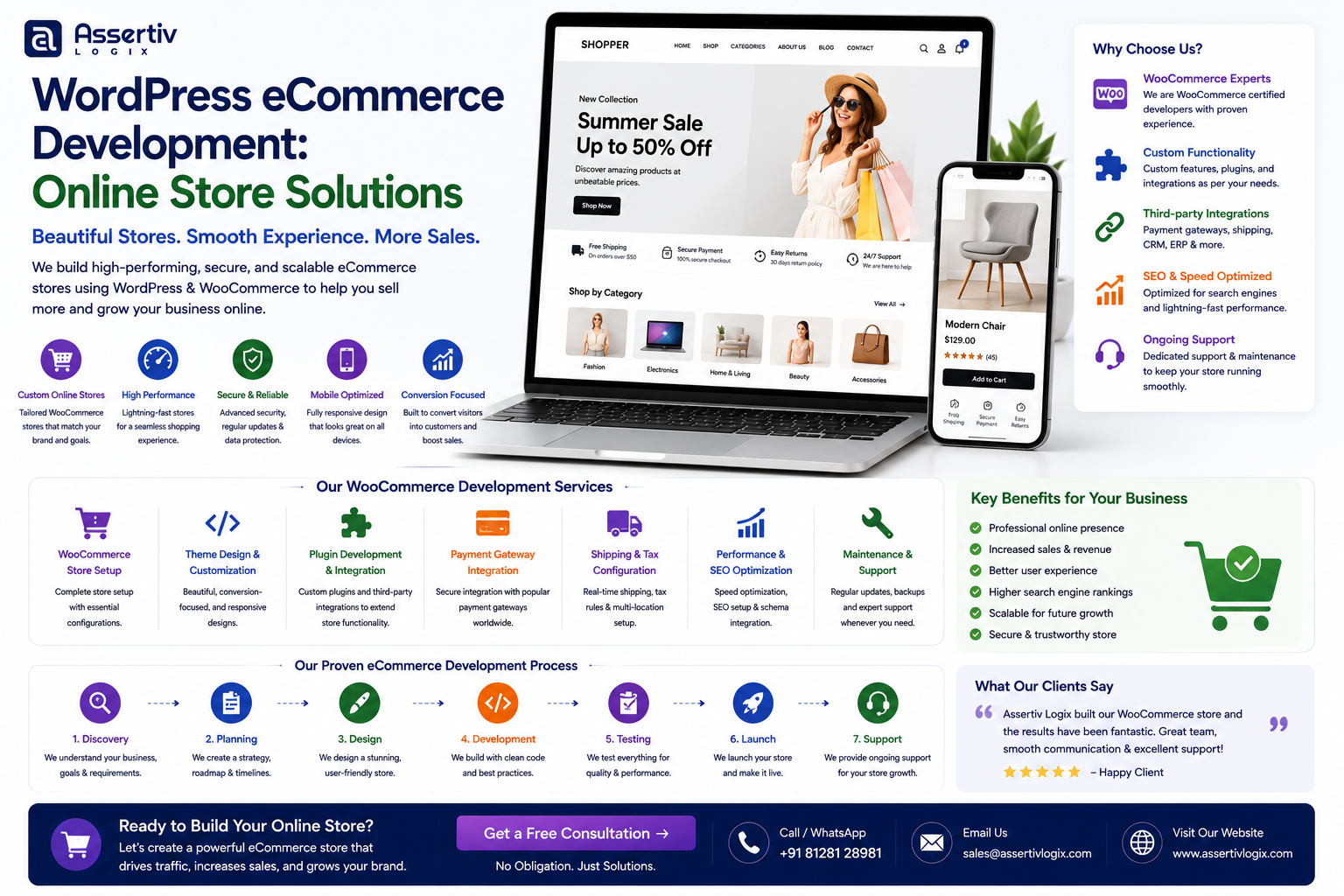
WordPress eCommerce development gives businesses a flexible way to build online stores that are tailored to their products, customers, sales processes, and growth goals. With WooCommerce and custom WordPress development, businesses can create everything from small online shops to sophisticated ecommerce platforms.
Launching an online store is not simply about adding products to a website. A successful ecommerce website needs a smooth shopping experience, reliable payments, secure customer accounts, optimized product pages, fast performance, mobile responsiveness, order management, shipping integrations, and a structure that can scale as sales increase.
This is where professional WordPress ecommerce development becomes valuable. Instead of relying entirely on pre-built themes and plugins, businesses can create custom functionality around their actual ecommerce requirements.
In this guide, we will explore WordPress ecommerce development, WooCommerce, custom online store functionality, payment integration, product management, security, performance, SEO, integrations, development costs, and how to choose the right ecommerce development partner.
Get expert WordPress and WooCommerce development for a fast, secure, scalable ecommerce website.
What Is WordPress eCommerce Development?
WordPress ecommerce development is the process of building, customizing, optimizing, and maintaining an online store using WordPress and ecommerce technologies such as WooCommerce.
Unlike a basic WordPress website, an ecommerce platform needs to manage products, customers, shopping carts, orders, payments, shipping, taxes, inventory, promotions, and other business processes.
WordPress provides the content management foundation, while WooCommerce provides ecommerce functionality that can be extended through themes, plugins, custom code, and integrations.
According to the official WooCommerce documentation, WooCommerce is designed as an ecommerce platform that can be extended for different store requirements.
Why Choose WordPress for eCommerce?
Businesses have many ecommerce platforms available today. WordPress can be an attractive option when flexibility, content marketing, customization, and control are important.
1. Flexible Store Management
WordPress provides businesses with control over content, product pages, landing pages, blog content, categories, and other website components.
2. WooCommerce Ecosystem
WooCommerce provides a broad ecosystem for products, orders, payments, shipping, subscriptions, and other ecommerce requirements.
3. Customization
Businesses can modify the store’s design and functionality instead of being limited to a fixed ecommerce template.
4. Content and eCommerce Together
For businesses that depend on SEO and content marketing, having ecommerce and content management on the same platform can simplify content publishing and store promotion.
5. Integration Options
WordPress ecommerce websites can integrate with payment gateways, CRMs, ERPs, inventory systems, shipping providers, marketing tools, analytics platforms, and external APIs.
6. Scalable Development
A properly engineered WooCommerce website can be optimized and expanded as the business grows.
WordPress eCommerce Development vs Standard WordPress Development
| Feature | Standard WordPress Website | WordPress eCommerce Website |
|---|---|---|
| Primary Purpose | Content and business information | Online sales and customer transactions |
| Products | Usually informational | Physical or digital products |
| Shopping Cart | Not required | Required |
| Payments | Optional | Core requirement |
| Orders | Usually not applicable | Required |
| Customer Accounts | Optional | Often required |
| Shipping | Usually not required | Often required |
| Inventory | Not applicable | Often required |
What Can You Build With WordPress eCommerce Development?
One of the biggest advantages of WordPress online store development is the ability to build different types of ecommerce businesses.
- Fashion stores
- Electronics stores
- Furniture stores
- Beauty and cosmetics stores
- Food and beverage stores
- Digital product stores
- Subscription businesses
- Membership stores
- B2B ecommerce websites
- Wholesale stores
- Marketplace-style platforms
- Booking and reservation stores
- Custom product stores
The architecture and ecommerce functionality should be selected according to the business model rather than simply copying another online store.
WooCommerce Development for Online Stores
WooCommerce is one of the most common foundations for WordPress ecommerce development.
A standard WooCommerce installation provides a starting point, but many businesses require customization.
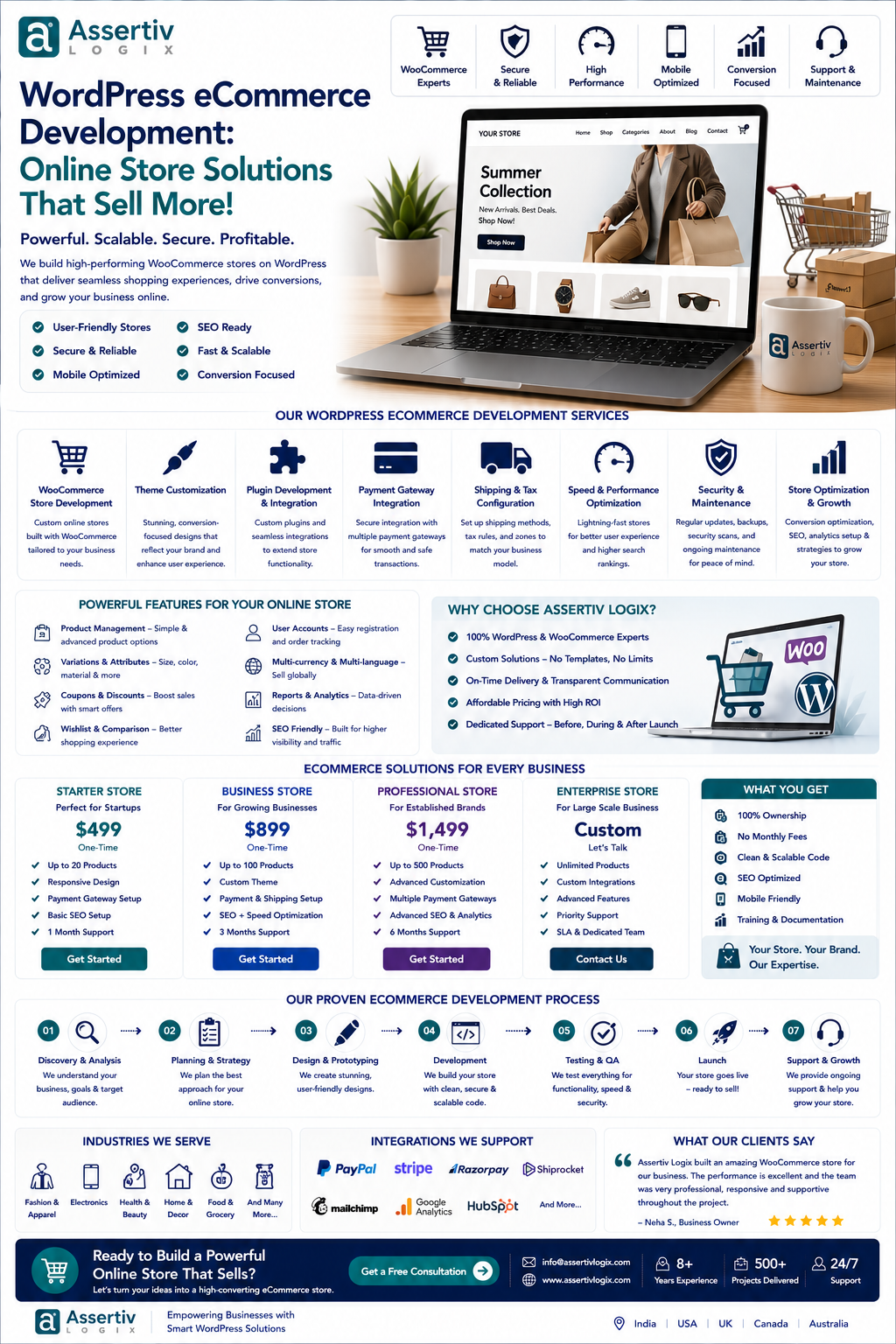
Professional WooCommerce development can include:
- Custom store design
- Custom product pages
- Product filters
- Custom checkout
- Payment gateway integration
- Shipping integration
- Tax configuration
- Inventory synchronization
- ERP integration
- CRM integration
- Custom pricing
- Subscription functionality
- Membership functionality
- Custom reporting
For businesses that need specialized functionality, custom WooCommerce development can provide a better long-term solution than continuously adding unrelated plugins.
Custom WooCommerce Store Development
Custom WooCommerce development allows businesses to create ecommerce functionality around specific operational requirements.
Custom Product Configuration
Businesses selling configurable products may require customers to choose sizes, colors, materials, dimensions, personalization options, or other product attributes.
Custom Pricing
B2B and wholesale businesses may require customer-specific pricing, quantity-based discounts, membership pricing, or negotiated rates.
Custom Checkout
A standard checkout may not match every business process. Custom checkout development can simplify the customer journey and collect information that is genuinely required for order processing.
Custom Order Workflows
Some businesses require additional order statuses, approval workflows, internal notifications, fulfillment processes, or integrations with external systems.
Payment Gateway Integration
Payment processing is one of the most important parts of an ecommerce website.
Depending on the target market, an online store may need to support multiple payment methods.
Payment integration can include:
- Credit and debit cards
- Digital wallets
- Bank payments
- Local payment methods
- Buy-now-pay-later services
- Recurring payments
Payment integrations should be implemented securely and tested carefully across successful payments, failed payments, cancellations, refunds, and other transaction states.
WooCommerce Shipping and Order Management
For physical products, shipping can be just as important as payment processing.
A custom ecommerce solution can connect WooCommerce with shipping providers to automate processes such as:
- Shipping rate calculation
- Shipping method selection
- Order fulfillment
- Tracking information
- Delivery notifications
- Regional shipping rules
Order management can also be integrated with warehouse, ERP, inventory, or logistics systems.
WordPress eCommerce API Integration
Modern ecommerce businesses often depend on several external systems.
WordPress ecommerce development can connect an online store with:
- CRM platforms
- ERP systems
- Inventory platforms
- Accounting software
- Shipping providers
- Payment gateways
- Email marketing platforms
- Customer support systems
- Analytics platforms
- Product information systems
WooCommerce provides developer resources and APIs that can be extended to support custom integrations. Developers can also refer to the WordPress REST API documentation when building API-driven functionality.
WordPress eCommerce Product Management
Product management becomes increasingly important as an online store grows.
A professional ecommerce platform should make it easy for store administrators to manage:
- Product names
- Descriptions
- Images
- Prices
- SKU numbers
- Inventory
- Product variations
- Categories
- Attributes
- Shipping information
Large stores may also require bulk imports, product feeds, automated synchronization, and connections with external product databases.
WordPress eCommerce SEO
Search visibility is essential for many ecommerce businesses.
Product pages should be structured so that search engines and customers can understand the products clearly.
An ecommerce SEO strategy can include:
- Optimized product titles
- Unique product descriptions
- SEO-friendly URLs
- Category optimization
- Internal linking
- Product structured data
- Image optimization
- Breadcrumbs
- Canonical URLs
- Technical SEO
- Page speed optimization
Businesses can refer to Google Search Central for official guidance on search visibility and technical SEO.
WordPress eCommerce Performance Optimization
Store performance can have a direct impact on the customer experience.
An ecommerce website may need to process product queries, filters, cart actions, checkout requests, payment communication, customer accounts, and third-party scripts.
Performance optimization may include:
- Page caching where appropriate
- Object caching
- CDN implementation
- Database optimization
- Image compression
- Modern image formats
- Lazy loading
- Efficient theme development
- Plugin optimization
- JavaScript optimization
- Server optimization
Public product and content pages can often benefit from caching, while cart, checkout, account, and other personalized experiences require careful handling.
Store owners can use Google PageSpeed Insights as one of the tools for evaluating page performance.
Mobile-Friendly WordPress eCommerce Development
A large percentage of ecommerce browsing happens on mobile devices. Therefore, mobile usability should be considered from the beginning of the design and development process.
A mobile-friendly store should provide:
- Responsive product pages
- Easy navigation
- Mobile-friendly filters
- Readable product information
- Fast-loading images
- Simple checkout forms
- Touch-friendly buttons
- Easy cart access
Mobile optimization should be tested on real devices and different screen sizes rather than relying only on desktop browser testing.
WordPress eCommerce Security
Ecommerce websites process customer information and transactions, making security a fundamental requirement.
A secure ecommerce development strategy should include:
- HTTPS
- Secure authentication
- Strong administrator access controls
- Regular WordPress updates
- WooCommerce updates
- Plugin vulnerability management
- Input validation
- Output escaping
- Secure API authentication
- Regular backups
- Security monitoring
Developers should also review the official WordPress security documentation when implementing custom functionality.
Scaling a WordPress eCommerce Website
A small online store and a high-volume ecommerce platform can have very different infrastructure requirements.
As traffic, products, orders, and customers increase, businesses may need to improve:
- Database performance
- Server resources
- Caching
- CDN configuration
- Search performance
- Background processing
- Image delivery
- Monitoring
Scaling should be based on actual bottlenecks rather than adding expensive infrastructure unnecessarily.
WordPress eCommerce for B2B Businesses
Not every ecommerce website sells directly to individual consumers.
B2B businesses may need custom ecommerce features such as:
- Customer-specific pricing
- Wholesale pricing
- Bulk ordering
- Quote requests
- Purchase orders
- Account-based catalogs
- Multiple users per company
- Approval workflows
- Credit-based purchasing
- ERP integration
WooCommerce can be extended to support these requirements through appropriate plugins and custom development.
WordPress eCommerce for Subscription Businesses
Subscription businesses require a different approach from traditional one-time ecommerce.
Depending on the business model, the platform may need:
- Recurring billing
- Free trials
- Subscription upgrades
- Subscription downgrades
- Cancellation
- Renewal notifications
- Failed payment handling
- Customer billing management
Subscription logic should be designed carefully so that payment events and customer account status remain synchronized.
WordPress eCommerce Website Development Process
A structured development process helps reduce errors and ensures that the store is built around business requirements.
Step 1: Business Discovery
Identify the products, target customers, sales model, markets, payment methods, shipping requirements, integrations, and business goals.
Step 2: eCommerce Architecture
Determine the WordPress and WooCommerce architecture, hosting, product structure, integrations, database requirements, and security approach.
Step 3: UX and Store Design
Design the homepage, category pages, product pages, cart, checkout, account area, search experience, and responsive layouts.
Step 4: WooCommerce Development
Implement the theme, product functionality, custom features, payment systems, shipping, taxes, integrations, and other ecommerce requirements.
Step 5: Content and Product Setup
Add products, categories, images, descriptions, pricing, attributes, shipping information, and SEO metadata.
Step 6: Testing
Test product browsing, search, filters, cart, checkout, payments, emails, shipping, coupons, customer accounts, mobile responsiveness, and integrations.
Step 7: Performance and Security Review
Optimize the website and review security before launch.
Step 8: Launch
Deploy the store with backups, analytics, monitoring, and appropriate production configuration.
Step 9: Ongoing Optimization
Continue improving the website based on sales data, customer behavior, performance metrics, and business requirements.
How Much Does WordPress eCommerce Development Cost?
The cost of WordPress ecommerce development depends on the size and complexity of the online store.
| Store Type | Complexity | Main Cost Factors |
|---|---|---|
| Small Online Store | Low to Medium | Products, design, payments, basic shipping |
| Custom WooCommerce Store | Medium | Custom UX, features, integrations |
| B2B eCommerce Platform | High | Pricing, accounts, approvals, ERP integration |
| Large WooCommerce Store | High | Catalog size, performance, integrations |
| Enterprise eCommerce | Very High | Infrastructure, scalability, security, complex integrations |
Major cost factors include the number of products, custom functionality, design requirements, payment gateways, shipping integrations, ERP or CRM integrations, migration requirements, performance requirements, and ongoing maintenance.
Common WordPress eCommerce Development Mistakes
Using Too Many Plugins
Adding a plugin for every small requirement can create unnecessary dependencies. Important functionality should be evaluated carefully before implementation.
Ignoring Checkout Experience
A beautiful store can still lose sales if checkout is confusing, slow, or unnecessarily complicated.
Using a Heavy Theme
Large ecommerce websites can suffer from unnecessary frontend code. A lightweight and carefully developed theme can provide a stronger performance foundation.
Ignoring Product SEO
Product pages need unique, useful content and appropriate technical SEO rather than relying only on product names and manufacturer descriptions.
Ignoring Mobile Users
A store that works well on desktop but is difficult to use on mobile can create unnecessary friction during the buying process.
Not Planning for Growth
The initial store may be small, but architecture should account for expected product, traffic, customer, and order growth.
How to Choose a WordPress eCommerce Development Company
Choosing the right development partner is important because ecommerce websites directly affect sales and customer experience.
Before hiring a development company, evaluate:
- WordPress development experience
- WooCommerce expertise
- Custom plugin development experience
- API integration capabilities
- Payment gateway experience
- Performance optimization skills
- Security practices
- Mobile development quality
- Testing process
- Post-launch support
Ask the development partner how they handle custom checkout, payment failures, integrations, backups, performance, security, and future feature development.
Why Choose Assertivlogix for WordPress eCommerce Development?
Assertivlogix provides professional WordPress and WooCommerce development services for businesses that need customized online store solutions.
Our development capabilities include custom WordPress development, WooCommerce development, custom themes, custom plugins, payment integrations, API integrations, website migration, performance optimization, security improvements, and ongoing maintenance.
Our goal is to create ecommerce websites that are not only visually appealing but also practical for customers and manageable for store administrators.
Whether you are launching a new online store, redesigning an existing WooCommerce website, migrating from another ecommerce platform, adding custom functionality, or improving store performance, the right development strategy can help create a stronger foundation for long-term growth.
Get a customized WordPress ecommerce solution designed around your products, customers, integrations, and growth goals.
Frequently Asked Questions About WordPress eCommerce Development
What is WordPress eCommerce development?
WordPress ecommerce development is the process of building and customizing online stores using WordPress, WooCommerce, custom themes, plugins, integrations, and other ecommerce technologies.
Is WordPress good for ecommerce?
Yes. WordPress with WooCommerce can be a flexible ecommerce solution for businesses that need control over their store design, content, functionality, integrations, and customer experience.
What is WooCommerce development?
WooCommerce development involves building, customizing, integrating, optimizing, and maintaining ecommerce functionality on a WordPress website using WooCommerce.
Can WordPress support a large online store?
Yes. A properly engineered WooCommerce website can support large catalogs and significant traffic when hosting, caching, database performance, integrations, and application architecture are designed appropriately.
Can WooCommerce integrate with payment gateways?
Yes. WooCommerce can be integrated with various payment providers. Custom development may be required when a business uses a specialized payment gateway or unique transaction workflow.
Can WordPress ecommerce websites integrate with ERP systems?
Yes. WooCommerce and WordPress can communicate with ERP systems through APIs or custom integrations to synchronize products, inventory, orders, customers, and other business data.
How much does WordPress ecommerce development cost?
The cost depends on store size, design, products, custom functionality, payment gateways, shipping, integrations, migration requirements, performance, security, and ongoing support.
Can you build a custom WooCommerce checkout?
Yes. Custom WooCommerce development can modify checkout fields, layouts, validation, payment flows, customer information, and other checkout requirements when the business needs a specialized experience.
Conclusion
WordPress ecommerce development provides businesses with a flexible foundation for building online stores that can be customized around their products, customers, operations, and growth objectives.
With WooCommerce, custom development, payment integrations, APIs, performance optimization, security, and ongoing maintenance, businesses can create ecommerce platforms ranging from small online shops to complex B2B and enterprise stores.
The most important decision is not simply choosing WordPress or WooCommerce. It is creating an ecommerce architecture that provides customers with a smooth buying experience while giving the business a reliable platform for managing products, orders, customers, and growth.
If you are planning a new online store or want to improve an existing WooCommerce website, contact Assertivlogix to discuss your ecommerce requirements.